

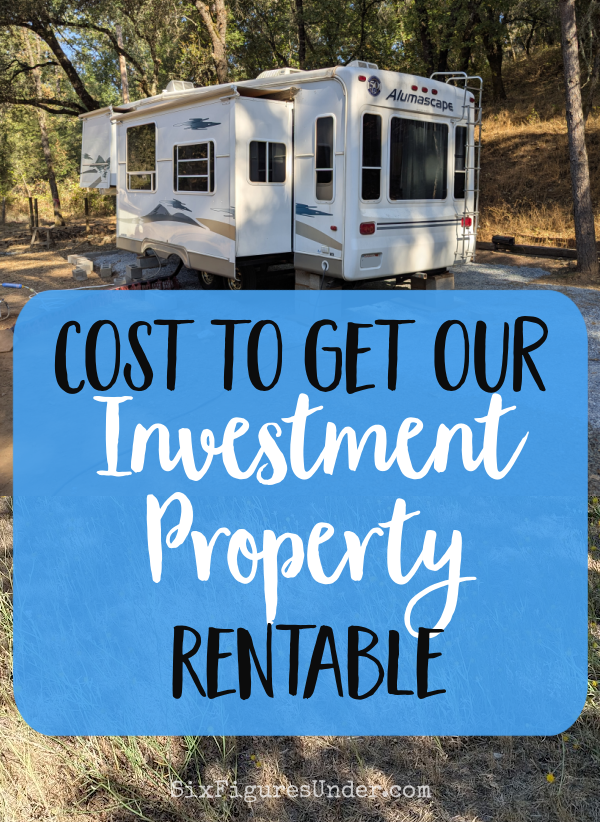
The next step on our investment property journey was to make an RV pad on the property so we could rent the space to someone who needs somewhere to park their RV. Renting space for parking an RV sounds pretty basic, but there’s a little more to it. These costs move us toward generating money with our property.
If you’re new to this series, we bought an investment property with a very rundown mobile home on it. We demolished the mobile home ourselves to we could keep costs to a minimum (and it was kind of fun). Because of a known zoning issue that is in the process of being resolved, we need to wait a bit before putting another permanent home on the property. Having someone rent an RV spot will contribute to the cost of the mortgage in the meantime and let us have someone there to keep an eye on things so it’s not a vacant property.
Cost to get our property ready for an RV
Here’s what we spent to get the property ready for an RV.
Electric $640
Of course the mobile home that was previously on the property had electricity, but all the wiring went from a separate main panel with just two breakers in it to a subpanel on the mobile home itself. That subpanel was torn out with the mobile home so we needed to add several breakers to the main panel, and new RV and standard outlets. While we were at it, we also wired up some lights on a pole and did a little work to be ready for the future home on the property. This was our most single most expensive line item because we had an electrician come out and do the work.
Gravel $370
Having an RV pad on the property isn’t a permanent thing for us, so we didn’t want to put down concrete. Still, we didn’t want our renter to deal with mud in the rainy season, so bare dirt wasn’t a great option either. We leveled the dirt on the pad and laid down 3 inches of 3/4 inch crushed limestone gravel with fines, a road base aggregate. With the rest of the load, we covered about half the driveway. It’s already proven a great investment as we’ve enjoyed several very wet storms this winter and the driveway stays hard and drains well.
Mailbox $267
The house needed a mailbox, so we went ahead and got a nice, extra large USPS-approved locking mailbox. With no visible neighbors and a huge increase in mail theft, we were willing to pay the cost of a locking mailbox. In fact, we’ve been thinking about putting one up at our house too. We expect this investment will keep being useful for many years even after we have a full home on the property.
Water lines and hardware $475
Unfortunately, we discovered that there was a leak somewhere between the well and the house (well, where the house used to be before the demo). We had no idea where the leak was, just that the water coming of the single spigot was sometimes black with dirt. Eww! Rather than search for the leak in the 40+ year old pipes, Mike just ran new PVC from the well to the RV site. He also added several other spigots at convenient spots while he was at it.
Trencher $194
In order to efficiently handle the water pipe project, we rented a trencher for a day from our local True Value hardware store.
Other tools/supplies $292
This includes ABS pipe and fittings to reroute the septic connection and add clean-outs, pipe insulation for the pop-up spigots, and a few other small things at Home Depot and True Value Hardware. There are always a few things that come up mid-project.
Verizon Equipment $25
We wanted our renter to have wifi. There is no fiber or copper available, so our only options in the area were Starlink, Verizon Business Wireless, or a local fixed wifi company. We chose to go with Verizon for a 25 Mbps connection at $75/month. The router was provided with a $25 initial shipping/setup fee.
In all, it cost us $2,263 to get our property ready for an RV renter after we finished demolishing and removing the old mobile home. Finding a renter turned out to be pretty easy. A friend helped me make a connection which turned out to be a great fit for both us and the renter. So far we have no complaints.
Ongoing monthly rental costs:
Originally we were planning to charge $800 per month with trash, internet, and electricity included. Our renter wanted to pay for her own electricity because she gets a special rate that is much better than what we would get, so we lowered the rent to $700 per month with just trash and internet included.
Trash $42
Since it’s just one person living there, we got the smallest garbage pick-up plan which includes a 35 gallon can picked up once a week, plus a 96 gallon recycle and yard waste bin, each picked up every other week. We are billed $83 every other month.
Internet $79
With our Verizon set-up, internet costs $79 each month for a 25 Mbps connection. So far it’s been clocking a little faster than that, which is more than adequate for our single renter who isn’t working from home or doing a lot of gaming.
So after these two expenses are taken into account, our RV space rental nets us $579 each month. Obviously this doesn’t come close to covering our $2,339 mortgage cost each month, but it definitely helps! In four months we’ll have repaid our initial prep costs and that $579 will reduce the out-of-pocket portion of our mortgage to $1760.
If you’re wondering where this shows up on our monthly budget update (here’s November’s budget update), look under “Investment Property.” Since we were not making a profit yet, I don’t include this income with our income. I put all of the RV rental expenses (including the mortgage) and income under the “Investment Property” budget line. We cover the remainder of the mortgage with money from our regular budget or from loan funds. (Our mortgage was for more than the cost of the property so that we would have cash to pay for putting a permanent house on the property as soon as the zoning changes).
How about you?
Was that more or less than what you expected?
If you’ve done a project like this, how did it go? What other expenses have you had or how did you save more?
