

(Investorideas.com
Newswire) a go-to platform for big investing ideas, including AI and
tech stocks issues market commentary from deVere Group.
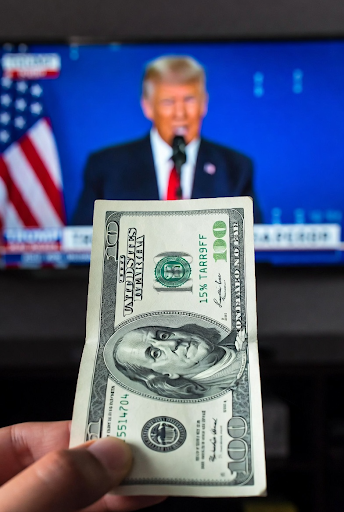
Trump’s new tariff threat is a “major credibility
test” for the US dollar, which has “just blinked,”
warns the CEO of one of the world’s largest independent
financial advisory organizations.
The warning from Nigel Green of deVere Group comes as the
world’s primary reserve currency slides 0.3% against a basket
of major peers, while gold rises 0.6% to $5,133 a troy ounce, after
President Trump unveiled a new 15% flat-rate tariff following a
Supreme Court ruling that his previous trade measures exceeded
executive authority.
Futures tracking the S&P 500 point to a 0.5% decline and the
Nasdaq 100 to a 0.7% fall.
“The dollar’s move may look modest in percentage terms,
but in currency markets 0.3% in a single session tied directly to a
policy announcement is meaningful,” says Nigel Green.
“It signals that global capital is reassessing risk at the
sovereign policy level.”
Trump is invoking the 1974 Trade Act to impose the new tariff for up
to 150 days after the Supreme Court ruled that earlier emergency
powers had been used beyond their lawful scope.
The legal confrontation adds a layer of institutional friction to an
already sensitive trade backdrop.
“The issue is not simply tariffs,” explains the deVere
CEO.
“It’s predictability. Reserve currency status rests on
deep capital markets, rule of law and policy coherence.
“When there’s visible tension between branches of
government over economic authority, investors price that into the
currency.”
The timing is significant. The dollar’s dominance has already
faced gradual erosion through ongoing dedollarization efforts.
Several emerging and major economies have expanded bilateral trade
settlement in local currencies, increased gold reserves, and
diversified foreign exchange holdings over recent years.
“While the dollar remains dominant in global reserves and
trade invoicing, incremental diversification has been underway.
“As some central banks are already trimming marginal dollar
exposure and increasing gold allocations, episodes like this
accelerate conversations about dedollarization,” says Nigel
Green.
“No single event dethrones a reserve currency. Credibility
shifts through accumulation of doubt.”
Gold’s 0.6% rise to $5,133 underscores that dynamic. Central
banks globally have been consistent net buyers of gold in recent
years, and renewed trade escalation strengthens the case for
hard-asset buffers.
A weaker dollar has direct and varied market
consequences.
For US investors, currency depreciation can lift multinational
earnings when overseas revenues are translated back into dollars,
potentially supporting equity valuations in export-heavy sectors.
At the same time, it can increase import costs, adding to
inflationary pressure domestically.
The CEO continues: “Dollar softness is a double-edged sword.
“It can boost the overseas earnings of US corporates, but it
also raises the cost of imported goods and commodities priced in
dollars, which feeds into margins and consumer prices.”
For global investors, the implications are equally
notable.
“A falling dollar typically supports commodity prices, as most
raw materials are priced in dollars. The rise in gold reflects that
relationship immediately. Energy and industrial metals can be
expected to follow if dollar weakness persists.
“Emerging markets often benefit in the short term from a
softer dollar, as dollar-denominated debt burdens become relatively
lighter and capital flows can rotate into higher-yielding
jurisdictions. However, volatility tied to trade disputes can offset
that benefit.”
Tech stocks, which have driven record highs on AI and tech
enthusiasm, were among the weakest segments in early trading.
European technology shares fell 0.9%, and US Nasdaq futures
indicated a 0.7% decline.
“AI supply chains are globally integrated. Tariffs increase
input costs, disrupt procurement channels and complicate
cross-border collaboration. Equity markets are starting to reflect
that,” says Nigel Green.
The 150-day window under the 1974 Trade Act provides a defined
timeframe, yet markets extend beyond legislative calendars.
“Capital allocators operate on forward expectations. If
investors conclude that trade policy can shift abruptly in response
to legal setbacks, they demand a higher risk premium on US assets.
The premium shows up first in currency markets.”
He concludes: “The dollar is showing vulnerability in a world
where dedollarization is already a strategic objective for some
economies, even a 0.3% move tied to credibility concerns is a
reminder that confidence is the foundation of reserve currency
power.”
