

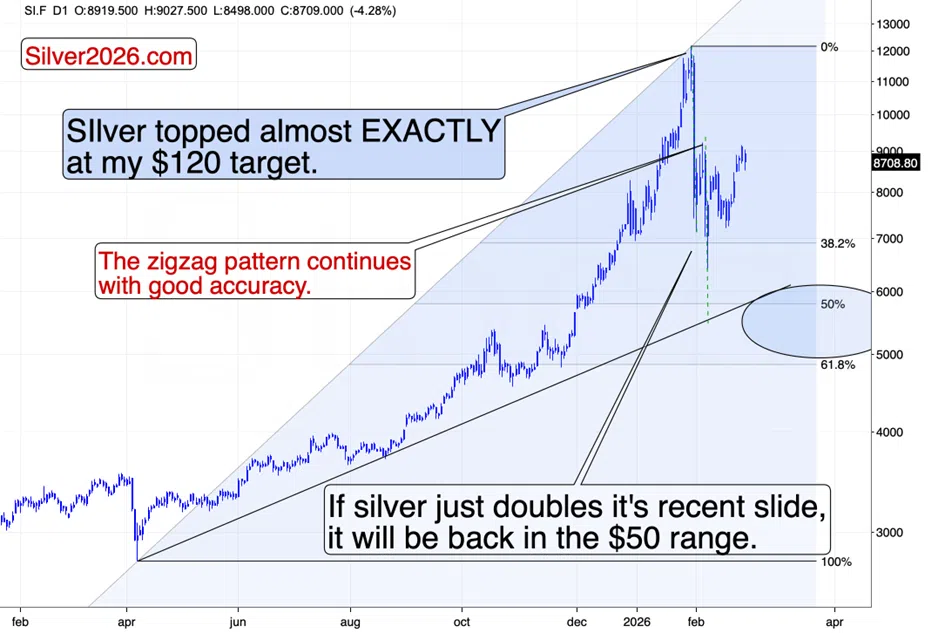
Silver is down today while other markets fluctuate.
This tells us two things:
1. Silver’s delivery notice day will probably (no
guarantees) not be a major issue.
2. The previously discussed outlook, based on the situation in the
USD Index, the situation in the stock market, and the link to the
post-2011 top price patterns, remains intact.
Silver price was down over 6% earlier today, and it moved slightly higher
since that time. But that’s not really important. The
important thing is that it’s not soaring right now – and
it should be soaring if tomorrow’s delivery notice was to
break COMEX. That’s what’s usually taking place before key events,
as some people have access to this information earlier and they
front-run trades. On a side note, that’s why paying attention
to technical matters – at times they tell you what’s
going on even before a piece of critical news hits goes public.
The link with the stock market remains clearly intact.
The first of the above two charts features the S&P 500 futures.
Please note that the declining resistance line was briefly breached
and then stocks moved back below it. When something like that
happened two weeks ago, it means that we’re about to see
bigger declines. Perhaps this time the move lower will be bigger
than just the short-term development.
Remember what triggered the 2020 slide? It wasn’t the pandemic
itself. It was when employment numbers shocked the market. And you
know what kind of news we keep hearing over and over again?
That AI is going to make many people lost their jobs. It seems that every tech CEO is warning about this. Given the
improvements in the AI and how fast they progress, this seems very
realistic to me. Remember – besides being a market analyst,
I’m also a business owner, so I have skin in the game.
Remember those few weeks when it was rather obvious that the
pandemic will spread like crazy and yet very few people seemed to
care / react to it? It seems to me we’re in the same stage but
with regard to the AI job displacement. Interestingly, it’s
approximately the same time of the year.
Just this week, JPMorgan’s Jamie Dimon told investors that JPMorgan
will likely employ fewer people in the next five years because of
AI-driven productivity gains. The bank already has 150,000 people using its AI model every week. He warned that society needs
to start preparing for AI-related job displacement now, not after it
happens.
Also, this week, Goldman Sachs warned that AI-related job losses are
already visible, and that unemployment could drift higher
to 4.5% by year-end (from 4.3%) partly
because of AI-driven displacement. If adoption is faster than
expected, the effect could be even bigger.
And that’s the moderate scenario.
Anthropic’s CEO Dario Amodei said AI could wipe out half of all entry-level white-collar jobs within five years. Microsoft’s AI CEO Mustafa Suleyman said
most white-collar work could be fully automated within 12 to 18 months. Fed Governor Michael Barr described a possible scenario where
many workers become “essentially unemployable.” An MIT study from
November found that AI can already do the job
of 11.7% of the U.S. labor market,
potentially saving up to $1.2 trillion in wages.
Remember – markets are forward looking. When people believe
that this will be the case, they won’t wait until it happens
to sell – they will sell right away.
In 2025, companies cited AI as a factor in about 55,000 layoffs. In
January and February 2026 alone, we’ve already seen Amazon cut
16,000 roles, Salesforce cut another 1,000 support jobs (after
already reducing that department from 9,000 to 5,000), Baker
McKenzie lay off up to 1,000 employees, and Meta cut 1,500 from
Reality Labs. All while pivoting budgets toward AI.
This is the equivalent of late January / early February 2020. The
signals were there. The pandemic was spreading. People were talking
about it. And yet, the stock market went sideways or up for several
more weeks before the crash. Then the employment data hit, and
everything fell apart.
Today, the signals are everywhere. They are on the front page of
every major business publication. And markets are still close to
their all-time highs.
Getting back to charts – it could be the case that the spike
in optimism is over. At least that’s what the bitcoin price is
suggesting.
After the quick run-up, it’s declining once again.
The USD Index is not moving in a meaningful way yet.
The above chart shows that the bottoms are in: the long-term one (as
the invalidation of the breakdown below the previous lows is a fact)
and the short-term one, as the USD index rallied back up after
reversing at the intersection of its support and resistance lines.
Zooming in reveals that the tension is rising. The rising support
line is near, and the USD Index just touched it. The declining
resistance line is also just ahead.
All this created a bullish cup-and-handle pattern, which now points
to a breakout – most likely in the near future as the space
between support and resistance narrows.
This breakout would be likely to lead to commodity and precious
metals values as well as lower stock values. The latter would be
likely to affect mining stocks, silver, and bitcoin more
than gold.
All in all, it seems that even though the fundamental case for silver remains exceptional, the case for a decline in the precious metals sector in the
following weeks and months remains strong.
Thank you for reading today’s free analysis. I’ll
continue to send you occasional updates and, as always, I’ll
keep my Gold Trading Alert subscribers informed (also on insurance-, investment-, and trading-capital-based details) at all times.
Thank you.
Przemyslaw K. Radomski, CFA
Founder
Golden Meadow®
Investorideas.com
is the go-to platform for big investing ideas. From breaking stock
news to top-rated investing podcasts, we cover it all.
Mining stocks -Learn more about our news, PR and social media,
podcast and content services at Investorideas.com
