

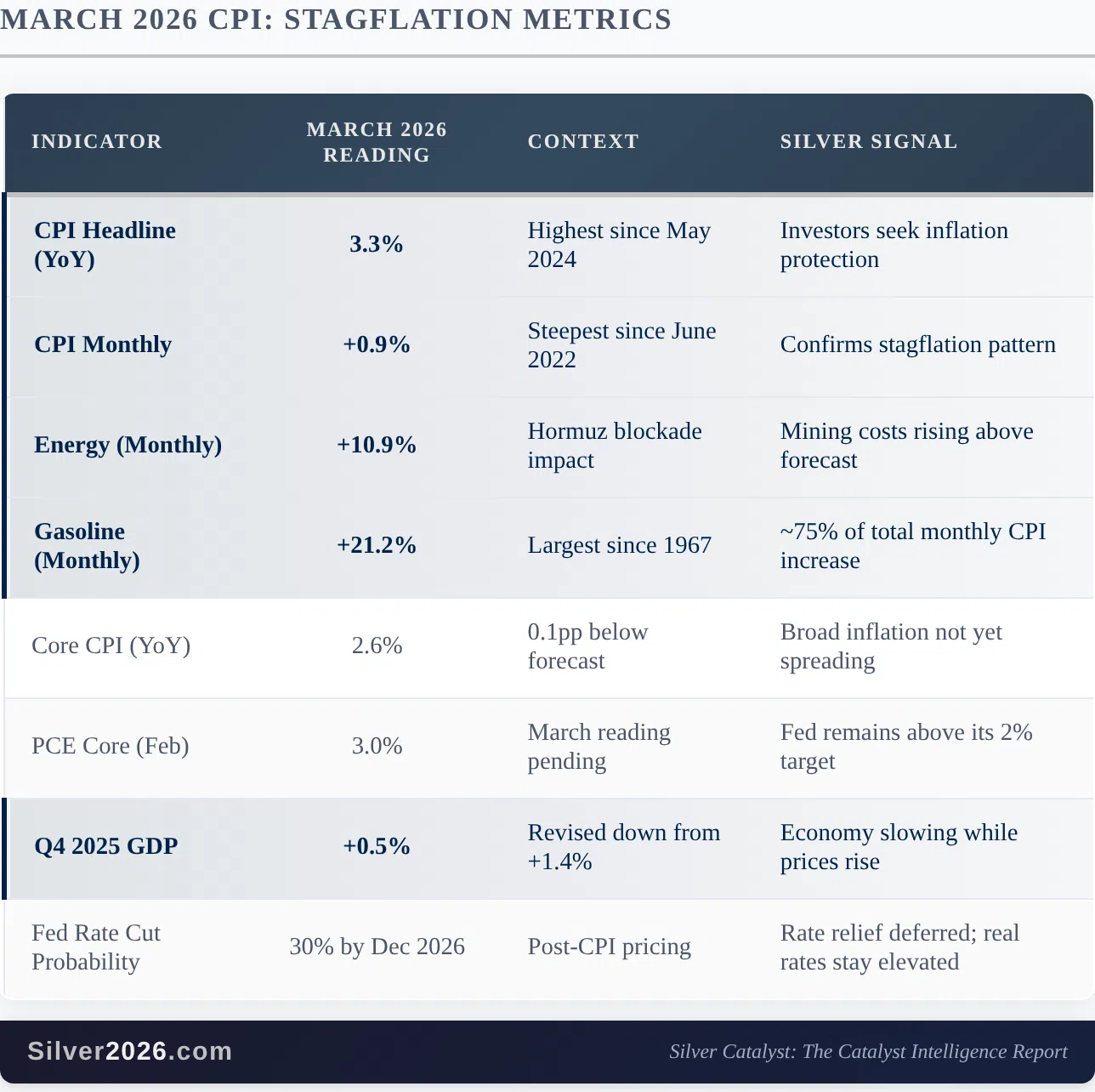
March CPI printed 3.3% — the highest reading since May 2024
— while Q4 GDP came in at 0.5%. Inflation above target.
The thesis this newsletter has tracked since Issue #1 just
arrived in official government data. Silver is 39% below its
January all-time high.
In Issue #10, I wrote about the stagflation trap taking shape in the silver market: a configuration in which inflation runs
above the Fed’s target while growth weakens below trend, leaving the
Fed unable to cut without adding to inflation and unable to raise
without accelerating a slowdown. At the time, the stagflation case
rested on analytical frameworks, leading indicators, and historical
parallels. It was a forecast, not a fact.
On April 10, it became a fact.
The Bureau of Labor Statistics released March 2026 CPI data:
headline inflation rose to 3.3%, the highest
since May 2024, driven by a 0.9% monthly jump — the steepest
since June 2022. The same week, the BEA revised Q4 2025 GDP growth
down to +0.5%, from an initial estimate of
+1.4%. Inflation above the Fed’s 2% target. Growth running well
below trend. That is the textbook definition of stagflation,
satisfied simultaneously in official government statistics for the
first time in this cycle.
There are eight Deep Dives in this week’s premium Silver Catalyst issue, and in this article, I’ll focus on one of them.
What the Data Actually Shows
The March CPI report contains a detail that matters for interpreting
the signal correctly.
Energy costs rose 10.9% in a single month, led by a 21.2% surge in
gasoline prices — the largest monthly gasoline increase since
1967, accounting for nearly three-quarters of the entire monthly CPI
increase. Core CPI, which strips out food and energy, came in at a
considerably more contained 2.6% year-over-year, 0.1 percentage
point below forecast.
Sources:BLS — Consumer Price Index Summary, March 2026 | BEA — Q4 2025 GDP Third Estimate, April 9, 2026 | Fox Business — PCE February 2026 | CME Group — FedWatch Tool
The distinction between headline and core matters here. The 3.3%
headline is driven primarily by energy — a direct result of
the Hormuz blockade and Brent crude trading above $100. If oil
prices moderate as the geopolitical situation evolves, April’s CPI
could reverse sharply. If oil stays elevated or rises further,
April’s reading will be hotter than March, because it is the second
consecutive month fully incorporating war-driven energy costs.
Bernard Yaros at Oxford Economics has already flagged that April CPI
will be “uncomfortably strong” regardless. The direction from here
is the critical variable.
What the core reading confirms is that the inflation problem is not
yet broad-based. It is concentrated in energy. That is relevant
because it means the Fed’s dilemma is more acute, not less: the
inflation it is being asked to fight is not the kind that rate
increases address effectively. Rate increases do not reduce oil
prices. They do not ease a supply-side energy shock. All they do is
make borrowing more expensive at the precise moment GDP is already
running at +0.5%.
The CME FedWatch tool puts the probability of even a single 25bps
cut by December 2026 at just 30%. Markets are pricing a 70% chance
that rates stay at 3.50–3.75% through year-end.
The Paradox, Explained
Silver is trading at $74.38 as of this morning — 39% below the
$121.67 all-time high set on January 29. The CPI just confirmed
stagflation. How are both of these things true simultaneously?
The short-term mechanism is straightforward. Higher-for-longer rates
strengthen the dollar and reduce the appeal of non-yielding assets
like silver. That dynamic capped silver’s rally after the April 8
ceasefire announcement — silver surged 7% in a single session
on US-Iran ceasefire news — and then drove Monday’s selloff
when Islamabad talks collapsed and the US blockaded the Strait of
Hormuz. The paper price responds to near-term rate expectations and
dollar strength. In the near term, both are working against silver.
The medium-term mechanism works in the opposite direction, and this
is where the stagflation analysis becomes directly applicable.
When cash earns 3.5% in interest and inflation is running at 3.3%,
investors holding cash are barely breaking even in real terms. The
difference between the nominal rate and the inflation rate —
the real interest rate — is essentially zero. As inflation
persists above the level the Fed is willing or able to fight, that
real rate turns negative. Negative real rates are, historically, one
of the most reliable drivers of precious metals demand, because the
opportunity cost of holding silver or gold versus cash disappears.
Per State Street’s April 2026 Gold Monitor, a 50bps decline in real
interest rates has historically translated to approximately
20–40 Moz of additional ETP investment demand for silver. That
demand has not arrived yet. Rates are being held, which is exactly
why silver is 39% below its January high despite the stagflation
thesis being confirmed in official data. The 20–40 Moz is not
a current market condition. It is a stored tailwind —
compressed by the rate hold, waiting for a pivot. The longer rates
are held while inflation persists, the more compressed that spring
becomes.
Why Silver Specifically, and Not Just Gold
Gold has gained approximately 26% year-to-date in 2026, trading near
$4,750 this morning. Silver is up only 4.6% over the same period.
The gold-silver ratio sits at approximately 63.8:1, against a
January low of approximately 45:1 when silver was surging.
The divergence is explained by the same rate mechanism: gold
benefits more immediately from monetary demand, while silver’s
industrial component creates a more complex near-term picture.
Industrial silver demand softens in a recession, and recession risk
is rising — Goldman Sachs, EY-Parthenon, and Moody’s Analytics
now put US recession probability between 30% and 49%.
But this is precisely where the stagflation dynamic introduces a
specific advantage for silver. Silver’s “dual nature” means that in
a stagflation environment, both of its demand drivers can activate
simultaneously. The monetary demand floor builds as real rates
compress. The industrial demand floor is maintained by structural
consumption from solar, EVs, AI data centres, and semiconductors
— sectors that do not contract during mild slowdowns at the
rate discretionary spending does. Gold has mostly monetary demand.
Silver has both.
The 1970s data make this concrete. Silver gained approximately
1,546% from December 1969 to December 1979 — from $1.83 to
$30.13 per ounce — across a decade defined by the Nixon gold
window closure, two oil crises, and chronic above-target inflation.
The current CPI trajectory at this precise inflection point maps
most closely to 1971–1974 in structure: 3.3% CPI at the
beginning of what became a multi-year inflation problem, with growth
already decelerating.
The current configuration does not need to replicate the 1970s to
generate significant silver performance. It simply needs to continue
in the direction the March data confirms it is already heading.
What This Means
The 3.3% CPI print activates Catalyst #59: Silver’s Regime-Dependent Inflation
Sensitivity from “Silver Rising” in hard, official government data rather
than in analytical frameworks. It upgrades Catalyst #65: 1970s Stagflation Precedent Shows Extreme
Performance from a structural narrative to a mainstream institutional
parallel now being cited across bank research. And it confirms the
environment that makes Catalyst #63: Dual Nature Providing Superior Protection specifically applicable: both demand levers becoming active
at the same time.
Silver is 39% below its January high. The fundamentals that drove
that high have not weakened. In the case of the stagflation thesis
— the central monetary argument for silver — they have
just received their strongest official confirmation to date.
The full Silver Catalyst Issue #13 covers seven more Deep Dives: the Hormuz blockade
and what $102/barrel oil means for silver’s mining cost floor, the
COMEX inventory situation with May delivery First Notice Day
approaching, the 64% semiconductor revenue surge and its industrial
silver implications, the Section 301 trade investigation closing
today and the tariff risk to Mexico’s 185–200 Moz annual
supply, the LBMA London vault drawdown and why the free float has
fallen below a single average day’s traded volume, the Samsung
solid-state battery commercial deployment timeline, and the Warsh
Fed confirmation delay and fiscal dominance as a structural argument
for why this inflation is difficult to contain. If you want to
follow silver’s performance throughout 2026 as this market develops,
I encourage you to get “Silver Rising” with complimentary 2-week access to the
Silver Catalyst newsletter.
Thank you.
The Silver Engineer
Investorideas.com
is the go-to platform for big investing ideas. From breaking stock
news to top-rated investing podcasts, we cover it all.
Mining stocks -Learn more about our news, PR and social media,
podcast and content services at Investorideas.com
