

(Investorideas.com
Newswire) a go-to platform for big investing ideas, including energy
stocks issues market commentary from deVere Group.
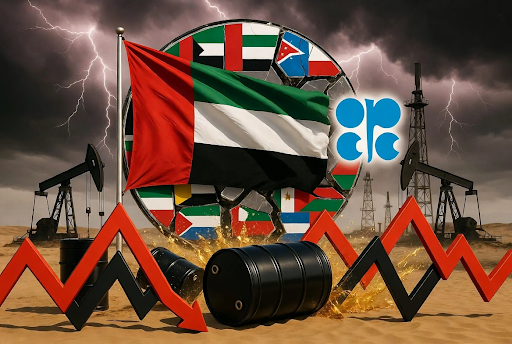
Oil markets are absorbing a structural shock following the United
Arab Emirates’ decision to exit Opec after six decades, a
break that strikes at the cohesion of a group long relied upon to
shape global supply and pricing, affirms the CEO of one of the
world’s largest independent financial advisory organisations.
The analysis from Nigel Green, CEO of deVere Group, comes as oil prices edged higher on the news but stopped short of
a breakout, with Brent crude trading around $111 a barrel after
briefly approaching $120 amid escalating tensions involving Iran and
disruption risks in the Strait of Hormuz.
“A core pillar of oil market stability has been removed by
this unexpected move.
“The UAE is not a marginal player. It’s one of the
very few producers with both meaningful spare capacity and the
operational flexibility to bring barrels online quickly, which has
been critical to how Opec has managed supply and influenced
pricing.
“Removing that capacity from a coordinated structure is
likely to create a more fragmented supply outlook at a point where
markets are already under pressure from the US-Iran war and
constrained shipping routes.”
“Oil is trading higher, but the reaction has, so far, been
pretty measured.
“Markets are already looking beyond the headlines to what
this means for future supply. There’s no immediate loss of
barrels, so the move reflects uncertain pricing rather than a
genuine supply shock.
“Near-term disruption risk is pushing prices up, while the
prospect of weaker producer coordination is limiting how far that
rally extends.”
Short term, conflict risk remains dominant. Any sustained constraint
through Hormuz keeps crude firmly supported, and a return toward
$120 remains “entirely plausible” if tensions intensify
or shipping flows are disrupted further.
Focus is shifting toward the structural implications for
Opec’s influence. The group’s pricing power has long
depended on a small number of members with spare capacity acting in
coordination, particularly Saudi Arabia and the UAE. A divergence
between those producers weakens that model.
Nigel Green says: “Medium term, the balance shifts. A less
cohesive Opec reduces the credibility of production caps and
forward guidance. The UAE has both the economic incentive and the
technical capacity to increase output independently, especially as
producers seek to maximise revenues during a period of
still-strong demand.”
Global oil consumption remains near record levels at more than 102
million barrels per day, supported by demand from major Asian
economies and a continued recovery in aviation. Supply growth
outside Opec has been inconsistent, leaving markets exposed to
internal fractures among exporters.
“Additional UAE supply over the next 12 to 24 months would,
we expect, begin to reshape pricing dynamics.
“Assuming geopolitical tensions stabilise, crude could move
back into an $80 to $95 range as incremental barrels come through.
Volatility, however, becomes embedded because coordination risk
does not disappear.”
The geopolitical dimension extends beyond energy markets.
The UAE’s repositioning comes alongside closer financial
engagement with the US.
President Trump has repeatedly criticised Opec’s role in
sustaining higher oil prices, and recent discussions around
potential currency support arrangements between US and UAE
authorities point to deeper strategic alignment.
“Stronger ties between the UAE and the US introduce a
different layer of influence,” notes the deVere chief
executive.
“Energy strategy, liquidity support, and currency stability
begin to intersect. A major producer stepping outside cartel
constraints while strengthening bilateral economic links with
Washington alters how global markets interpret supply
signals.”
Longer-term implications are tied to the trajectory of global energy
demand and the economics of production. Low-cost producers with
expansion capacity face increasing pressure to accelerate output
while demand remains structurally high.
“Longer term, this reflects a strategic shift already
underway.
“Producers with scale and low extraction costs are
prioritising volume, aiming to monetise reserves before demand
eventually plateaus. Sustained collective discipline becomes far
harder to maintain, and competitive pressure increases across the
market.”
Markets are already responding across asset classes. Energy equities
have moved higher alongside crude, while inflation expectations
remain sensitive to prolonged oil strength given the direct
pass-through to transport and industrial costs.
“Energy markets are becoming harder to read.
“Fewer shared decisions, more independent moves, and rising
geopolitical pressure mean prices will likely swing more and
adjust faster.”
Research oil and gas stocks at Investorideas.com’s free stock
directory
https://www.investorideas.com/OGSN/stock_list.asp
Research Natural gas and helium stocks at
Investorideas.com
https://www.investorideas.com/Companies/NaturalGas/Stock_List.asp
Investorideas.com
is the go-to platform for big investing ideas. From breaking stock
news to top-rated investing podcasts, we cover it all. Our original
branded content includes podcasts such as Exploring Mining, Cleantech,
Crypto Corner, Cannabis News, and the AI Eye. We also create free
investor stock directories for sectors including mining, crypto,
renewable energy, gaming, biotech, tech, sports and more. Public
companies within the sectors we cover can use our news publishing and
content creation services to help tell their story to interested
investors. Paid content is always disclosed.
Learn more about our news, PR and social media, podcast and content
services at Investorideas.com
