

(www.investorideas.com
Newswire) Silver Price Analysis article from The Silver Engineer.
A pipeline rupture, an emergency state finance package for
Petroperu, and Strait of Hormuz pressure on imported diesel
together put roughly 15% of global silver mine supply under acute
energy-cost pressure.
Eight days after Issue #16 went out, silver sits at roughly $72.81
in early Friday trading on June 5, under sustained macro pressure
from the Iran-Israel-Lebanon situation, sticky inflation
expectations, and a US payrolls release due this morning. Markets
are pricing the energy-shock channel, not the physical-silver
channel.
Two articles ago I
wrote about India pulling the world’s largest physical-silver
bid. Earlier this week I covered
why the COMEX vault grew by 4.8 million ounces in eleven days. Today’s story sits on the other side of the balance sheet. It is
about the country that produces about 15% of the world’s silver, the
energy disruption running through its mining sector, and the part of
the math that does not respond when grid power costs quintuple.
What Just Happened in Peru
Start with the trigger. On May 11, the transition government under
President Jose Maria Balcazar issued
Decreto de Urgencia 003-2026, authorizing a US$2 billion contingent finance package for
Petroperu alongside an additional US$500 million short-term
commitment. State finance packages of that size in a single decree
are usually a response to something acute. In this case, the acute
thing is the energy grid itself.
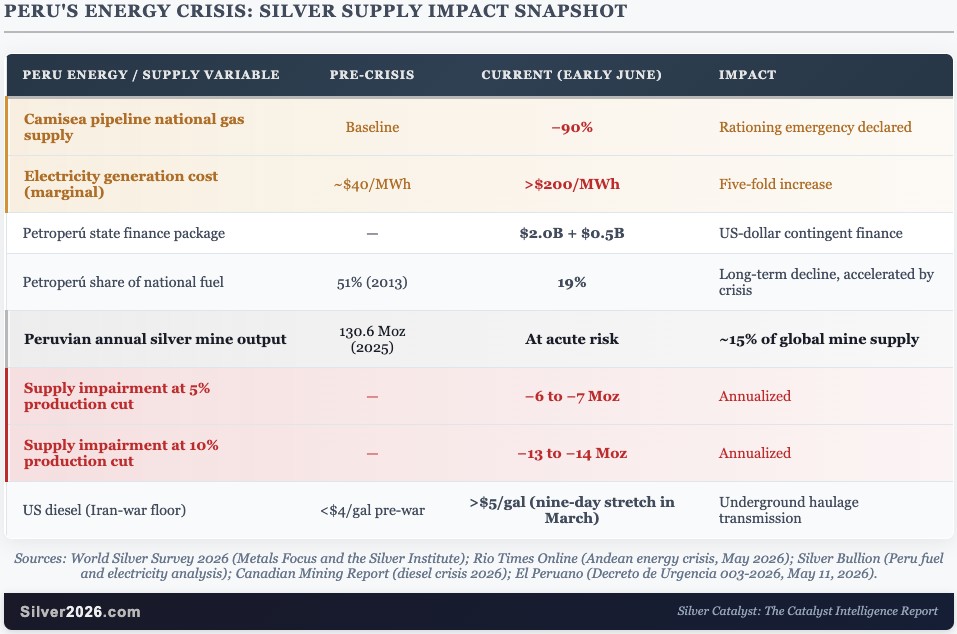
The chain runs back to a March rupture in the Camisea pipeline, the
largest natural-gas conduit in Peru. Per
Rio Times reporting on the Andean energy crisis, the rupture cut Peru’s national gas supply by approximately 90%
and pushed marginal power costs from around $40 per MWh to over $200
per MWh, a fivefold increase. The marginal generator is the last
power plant the grid has to switch on to meet demand, and it is the
one that sets the price for everyone else. When that price
quintuples and stays there, every industrial consumer downstream of
it gets the bill, even the ones who never use the marginal generator
directly. The government declared a rationing emergency, suspended
natural gas exports, and drew on strategic petroleum reserves.
Now layer in the silver side of the math. Peru produced 130.6
million ounces of silver in 2025 per the World Silver Survey 2026
from Metals Focus and the Silver Institute, approximately 15% of the
846.6 million ounces of global mine production the Survey
reports
for the year. That production comes overwhelmingly from underground
polymetallic operations, which means most of Peru’s silver is
byproduct silver, pulled out of zinc, lead, and copper ore.
Underground polymetallic mines are not energy-flexible. Their
processing-electricity baseline runs at roughly $0.68 to $1.60 per
ounce in normal conditions. A five-fold jump in marginal power costs
sits on top of that baseline, not in place of it.
The diesel channel is the second pressure. Per
Silver Bullion’s analysis, Petroperu’s share of national fuel supply has fallen from 51% in
2013 to 19% today, and the country imports the difference. The
Canadian Mining Report’s analysis of the diesel crisis
noted that US diesel held above $5 per gallon for nine consecutive
days in March, with the higher floor persisting into May.
Underground mines run on diesel for haulage and for backup power,
and the Strait of Hormuz situation has kept the imported diesel both
scarce and expensive. Newmont’s
Q1 2026 release
explicitly named higher oil prices as a Q2 cost headwind across its
Boddington, Tanami, Lihir, and Penasquito operations.
A 5% production cut tied to power rationing and fuel-cost
compression removes 6 to 7 million ounces from Peruvian annual
output. A 10% cut, which is closer to what marginal underground
operations could plausibly face when grid power costs quintuple,
removes 13 to 14 million ounces. Across all 2026 global mine supply,
marginal-cost pressure on deferred development decisions plausibly
adds another 2 to 4 million ounces of impairment beyond Peru itself.
Those figures are scenario-based estimates rather than reported
forecasts, and the honest framing matters. Some of the lost output
will be made up by partial substitution from other regions or by
accelerated production at lower-cost operations elsewhere. Some of
it will not.
There are also genuine offsets inside the Peruvian story.
Buenaventura, the largest source of Peru’s byproduct silver across
its zinc and lead operations, has been working on a
potential 16-year extension at San Gabriel
and is ramping
Tantahuatay toward full capacity in 2026. Both are real improvements at the project level. Neither changes
Peru’s near-term energy vulnerability. If the Iran-US negotiation
framework stabilizes, the upstream energy-shock pressure eases and
the diesel floor recedes over time. If it collapses, which the
Hezbollah rejection and the Iranian foreign minister’s comments this
week make at least as plausible as a deal, Peru’s vulnerability
compounds rather than abates.
What This Means
The near-term price will not be set by Peru’s gas grid. It is going
to be set by the May payrolls print landing this morning, by how the
Iran-Israel-Lebanon situation evolves over the weekend, by whether
the December Fed-rate-hike probability keeps grinding higher or
starts to ease, and by the CFTC Commitments of Traders report that
releases at 3:30 PM Eastern this afternoon covering June 2
positions. Silver in a $72 to $79 range reflects sustained macro
headwinds. That part of the story is real and worth respecting.
But the Peru piece is the kind of supply-side development that does
not show up in the daily chart and is the kind that compounds over
months. Across the impairment scenarios in the table, you are
looking at 6 to 14 million ounces of plausible 12-month Peruvian
supply destruction, layered on top of a sixth consecutive structural
deficit forecast by
Metals Focus and the Silver Institute in the World Silver Survey
2026
at 46.3 million ounces for 2026. The deficit math gets harder if
Peru loses meaningful production at the same time India’s
demand-side throttle is offsetting some of the global investment
buying. The deficit math eases, in the other direction, if the Iran
situation resolves and the energy curve flattens.
The honest read is that silver is sitting between a near-term
repricing risk that is real and a structural setup that keeps
getting tighter in the places that count. Earlier in this cycle,
supply news of this kind moved silver sharply higher; in the current
macro environment, the rate and geopolitical channels are
overshadowing it. That mismatch is not a refutation of the supply
story. It is a feature of how silver trades when two large forces
pull in opposite directions. The June 5 trading screen is the first
one. The Peruvian power grid is the second one. Both are happening
at once. The first is what shows up in your brokerage account today.
The second is what determines whether the deficit number widens,
holds, or eases through the back half of 2026.
That tension sits at the heart of my longer-term silver forecast.
The supply-side news has been getting worse for months, not better.
Peru is the largest single-country pressure point in that picture,
and the Decreto de Urgencia is the moment the pressure became
operational. Energy supply that was always a background risk is now
a foreground constraint, and the underground mines that produce most
of the country’s silver are running into a power-cost shock they
cannot pass through and a diesel floor they cannot avoid.
Peru is one dimension of the 100-catalyst framework I analyze in
Silver Rising, alongside the seven other Deep Dives in this issue. If you want
to understand where this market is headed, I encourage you to
get Silver Rising with complimentary access to the
Silver Catalyst newsletter.
Thank you.
The Silver Engineer
Investorideas.com
is the go-to platform for big investing ideas. From breaking stock
news to top-rated investing podcasts, we cover it all.
Mining stocks – Learn more about our news, PR and social media,
podcast and content services at Investorideas.com
