

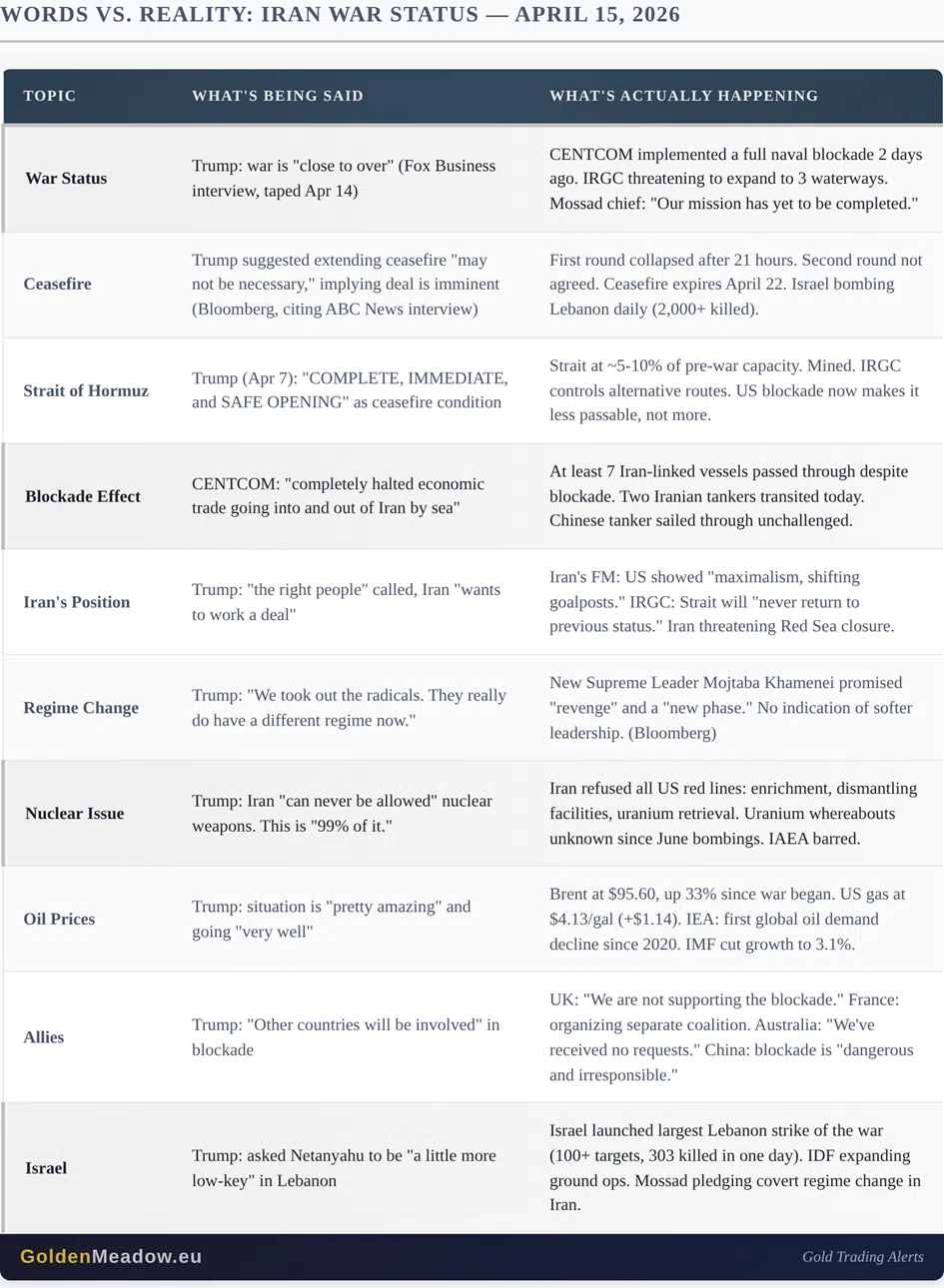
Trump told Fox Business the war is “close to over.”
He told ABC News that extending the ceasefire “may not be
necessary.” He told the New York Post that talks could restart “over
the next two days.”
Oil is at $95.60. Up 33% since the war began. The Strait is mined.
The blockade is in effect. Iran is threatening to close the Red Sea.
Israel’s Mossad chief just pledged more covert operations to topple
Iran’s government. The IAEA has been barred from Iran’s nuclear
sites since June.
Something doesn’t add up. I built the table below to help visualize
the gap.
Managing the News Cycle, Not the Crisis
Bloomberg flagged the pattern directly: “Trump has vacillated
throughout the war between declaring it all but over and threatening
a major escalation.” That’s not editorial commentary. That’s a
factual description of what happened this week alone. Sunday: “BLOWN
TO HELL.” Monday: “they called, they want a deal.” Tuesday: war is
“close to over.” Wednesday: still running a naval blockade with 15
warships.
The market response to these statements has been predictable. Each
optimistic comment produces a relief rally. Stocks have now erased
all losses since the war began on February 28. The S&P is
closing in on its January record high. But oil is still at $95.60,
gas is at $4.13, the Strait is still closed, and the IMF just
downgraded global growth to 3.1%.
Stocks are pricing Trump’s words. Oil is pricing the physical
reality. One of them is wrong.
I don’t know which one resolves first. But I do know that every
previous relief rally this year (tariff pauses, ceasefire
announcements, “they called” comments) faded within 48-72 hours as
the structural reality reasserted itself. Yesterday’s TACO bounce is
already fading: gold gave back its gains, oil is rising again, and the dollar is firming.
The Blockade is “Fully Implemented” and Already Leaking
CENTCOM claimed it has “completely halted economic trade going into
and out of Iran by sea” in less than 36 hours. Admiral Cooper said
90% of Iran’s economy depends on sea trade.
But the data tells a different story. At least 7 Iran-linked vessels
passed through the Strait after the blockade began (Kpler data). Two
Iranian tankers transited today, according to Fars News. A second
sanctioned Chinese vessel (Elpis) passed through yesterday. The
Chinese-owned Rich Starry sailed through, then made a U-turn near
Larak Island for unclear reasons. A US official confirmed the Navy
did not ask it to turn back.
A US official clarified that the blockade is being enforced from the
Gulf of Oman, not the Strait itself. Ships can get through Hormuz,
but not far past it. An Iraq-bound supertanker made it through on
its second attempt, becoming the first crude carrier to head west
through the Strait since the blockade began.
So “completely halted” is aspirational, not descriptive. The
blockade is real, but it’s porous. Iran is testing it carefully,
sending vessels through to see what happens. The US is enforcing
selectively, avoiding confrontation with Chinese vessels while
trying to squeeze Iranian exports. (One of my subscribers raised an
interesting point about China’s role as Iran’s “untapped leverage”
that goes well beyond oil shipments. I addressed it in detail in
today’s full Gold Trading Alert.)
Iran’s response to the blockade: Iran’s army warned it could block
traffic in the Persian Gulf, the Sea of Oman, AND the Red Sea if the
US blockade continues. That’s the explicit three-waterway threat. If
Iran activates the Houthis to close Bab al-Mandeb simultaneously,
global shipping faces two chokepoints closed at once. That scenario
is not priced in.
But there’s a more subtle Iranian response happening too. Bloomberg
reported that Iranian authorities are considering a pause in their
own shipments through Hormuz to avoid testing the blockade and
jeopardizing fresh negotiations. That’s strategic restraint, not
weakness. Iran is choosing not to provoke an incident that would
give Trump a military win while the diplomatic track (where Iran
holds stronger cards) is still alive.
The Treasury Tightens While Trump Talks Peace
While Trump says the war is “close to over,” the Treasury Department
is doing the opposite. The temporary waiver allowing the purchase of
certain Iranian crude oil expires this weekend. A similar waiver for
Russian crude already lapsed last week. Treasury warned banks about
moving funds supporting the Iranian regime.
This is maximum economic pressure being applied at the same time the
President is claiming a deal is imminent. The two messages don’t
align. Either the Treasury is running on autopilot and hasn’t
received the “close to over” memo, or the “close to over” rhetoric
is for markets, and the actual policy is escalation. Based on the
pattern of the past seven weeks, I think it’s the latter.
The Mossad Statement Nobody is Talking About
The most important sentence published today got almost no market
attention. Israel’s outgoing Mossad chief David Barnea said: “Our
mission has yet to be completed.” He pledged more covert efforts to
topple Iran’s government.
This is Israel saying, in plain language, that it will continue
destabilizing Iran regardless of what Trump negotiates. Any peace
deal between Washington and Tehran is undermined the moment Israeli
intelligence resumes operations designed to change Iran’s regime.
This is the same structural contradiction that collapsed the
ceasefire in 12 hours on April 8: Israel operates independently, with objectives that conflict with
US diplomatic goals. Trump can sign whatever deal he wants.
Netanyahu and Mossad will pursue their own agenda.
For markets, this means: the risk never fully goes away. Even a
signed US-Iran agreement doesn’t eliminate the tail risk of Israeli
covert action provoking an Iranian response that restarts the cycle.
IEA: First Global Oil Demand Decline Since 2020
The IEA said Tuesday that surging prices of jet fuel and gasoline
are “already squeezing consumers,” pointing toward the first annual
decline in global oil demand since 2020. Global oil demand is
expected to fall by 80,000 bpd in 2026, with the Middle East and
Asia-Pacific seeing the steepest drops.
“Demand destruction will spread as scarcity and higher prices
persist,” the IEA said.
This is the point I raised earlier this week about oil’s natural
ceiling. Prices high enough to cause demand destruction ($130-170
range) would eventually bring supply and demand back into balance.
But we’re not there yet. At $95.60, prices are high enough to hurt
consumers and slow growth, but not high enough to force the
behavioral changes (rationing, factory shutdowns, flight
cancellations) that would meaningfully reduce demand. The IMF’s 3.1%
growth forecast reflects the pain without the relief.
In yesterday’s analysis, I featured a chart that showed what happened to precious metals
and mining stocks after the previous two times crude oil decisively
broke above $100. In both cases, major declines followed in
gold, silver,
and mining within months. In 2008, GDX erased more than 2/3 of its
value, and FCX lost about 4/5. The pattern makes sense: high crude
oil means high costs for companies, which crushes profits and stock
prices. This is even worse than most investors realize: diesel alone
accounts for 46% of total mine energy consumption, and the vast
majority of junior miners have no hedging programs to protect
against it. I go through the research in today’s full Alert.
For the gold thesis: demand destruction and slowing growth are
normally bullish for gold (flight to safety, rate cut expectations).
But this particular slowdown is driven by supply-side inflation
(oil), which keeps the Fed frozen. The channel holds: oil up →
inflation sticky → Fed frozen → dollar supported →
gold pressured. Even if growth slows, the Fed can’t cut into an
oil-driven inflation surge. That’s the stagflationary trap.
Today’s Prices: The TACO Fades
Gold: $4,832, down 0.37%. Silver: down 0.66%. Oil (WTI): up 0.92%.
Dollar (DXY): up 0.11%. S&P: up 0.06%. Copper: down 0.11%.
It seems that yesterday’s relief rally lasted one session. Gold is
giving back gains. Oil is climbing again. The dollar is firming.
Silver is fading. The pattern: TACO bounce on Tuesday, channel
reasserts on Wednesday.
This is the fifth time in two weeks that the channel has reasserted
after a headline-driven disruption. The structural driver (oil
elevated → inflation → Fed frozen → dollar strong
→ gold pressured) is more powerful than any single Trump
statement, blockade announcement, or “they called” claim.
The test I outlined yesterday remains: if oil falls for three or more consecutive sessions
and Strait traffic increases meaningfully, the channel is breaking.
As of today, oil is up, not down. The channel holds. Mining stocks,
meanwhile, may have just hit a turning point: the
triangle-vertex-based reversal I flagged yesterday for subscribers
played out today, and silver’s move to its 38.2% Fibonacci
retracement and reversal below $80 added confirmation.
Thank you for reading today’s article – the free version of
today’s Gold Trading Alert. Subscribers receive the full analysis
with charts, technical levels, and trading positions daily. Gold Trading Alerts are available directly and through the
Diamond Package.
Thank you.
Sincerely,
Przemyslaw K. Radomski, CFA
Investorideas.com
is the go-to platform for big investing ideas. From breaking stock
news to top-rated investing podcasts, we cover it all.
Mining stocks -Learn more about our news, PR and social media,
podcast and content services at Investorideas.com
