

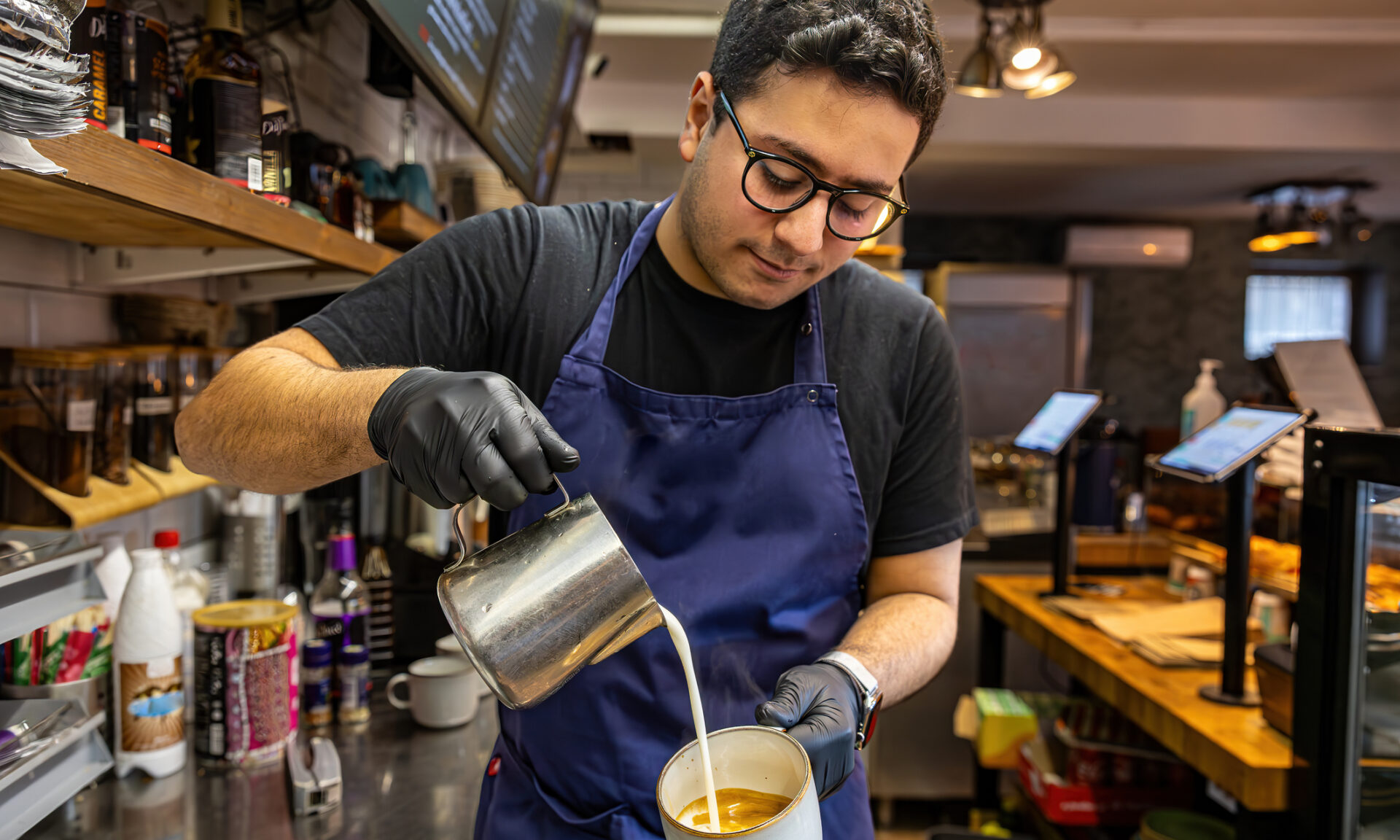
Coffee shops need business insurance to protect their employees, comply with lease requirements and protect themselves against lawsuits.
Typically, coffee shops need to have:
General liability insurance. This covers your legal costs if a customer or client sues you because they get injured or sick at your shop.
Commercial property insurance. This covers repairing or replacing damaged property. It can pay out after a theft or natural disaster. Look for endorsements that cover food spoilage and equipment breakdown too.
Workers’ comp. Most states require this insurance if you have one or more employees.
Read on to make sure your coffee shop is fully insured.
Save up to 30% on business insurance
NerdWallet Small Business helps you get real-time quotes from 30+ insurers, and instant access to your Certificate of Insurance (COI) through our partner, Coverdash.
Best coffee shop insurance companies
Receive relatively few general liability complaints and commercial property complaints to state insurance regulators based on their size.
Are financially strong according to credit rating agencies, meaning they have the ability to pay claims.
Offer important endorsements on their BOPs, like spoilage and off-premises utility coverage.
Make it easy to get a quote and buy a policy.
Here are our top three recommendations for coffee shops. We always suggest getting multiple quotes to find the best coverage at the best price.
Why trust NerdWallet
250+ small-business products reviewed and rated by our team of experts.
80+ years of combined experience covering small-business and personal finance.
Objective, comprehensive small-business insurance ratings based on the financial strength, complaint records, digital features and customer service availability of insurance market leaders. Read our methodology. NerdWallet’s small-business insurance content — including our ratings, reviews and recommendations — is produced by a team of writers and editors who specialize in small-business finances. Their journalism has appeared in The Associated Press, Washington Post, MarketWatch, Nasdaq, Entrepreneur, ABC News, MSN and other national and local media outlets. Each writer and editor follows NerdWallet’s strict editorial guidelines to ensure fairness and accuracy in our coverage.
Best business owner’s policy
NerdWallet’s ratings are determined by our editorial team. The scoring formula takes into account consumer complaint and customer satisfaction data.
The Hartford is a century-old insurance company with strong financial strength ratings and relatively few customer complaints. It sells nearly every type of business insurance, including a BOP with plenty of endorsements. Those include coverage for data breaches, employment practices liability and spoilage. You can also get business income protection if food contamination forces your shop to close.
Best for getting coverage fast
NerdWallet’s ratings are determined by our editorial team. The scoring formula takes into account consumer complaint and customer satisfaction data.
BiBERK is an online subsidiary of Berkshire Hathaway. If you need coverage fast, you can buy a BOP and workers’ comp online with biBERK in a matter of minutes. You can also add a variety of protections to your BOP — coverage for equipment breakdown, food spoilage, off-premises utility interruption and employment practices liability.
Unfortunately, biBERK only sells BOPs in around 30 U.S. states. Georgia, Wisconsin and Oregon are excluded, among others. Check their coverage map here to see if you’re eligible. Policyholders have also filed far more complaints about biBERK with state regulators than we’d expect, given the company’s market share. Read NerdWallet’s review of biBERK business insurance.
Best for working with an agent
NerdWallet’s ratings are determined by our editorial team. The scoring formula takes into account consumer complaint and customer satisfaction data.
Nationwide’s business owner’s policy includes equipment breakdown coverage, which doesn’t usually come standard. That’s important if you rely on an espresso machine or precision coffee grinder and don’t have a backup. Beyond that, Nationwide sells every type of insurance your cafe is likely to need. That includes workers’ comp, employment practices liability insurance, employee dishonesty insurance and more.
Some customers can get a Nationwide quote online, but you’ll have to call or connect with an agent to finish your purchase. If you want to talk to an agent for help understanding your risks and shopping around, look for one that sells Nationwide policies. Read NerdWallet’s review of Nationwide business insurance.
Save up to 30% on business insurance
NerdWallet Small Business helps you get real-time quotes from 30+ insurers, and instant access to your Certificate of Insurance (COI) through our partner, Coverdash.
What is coffee shop insurance?
Coffee shop insurance helps protect your business in case you’re sued, your equipment breaks down or fire or bad weather damages your building.
Here are some additional common risks that cafes face and insurance can help cover:
Customer illness or accidents, like the classic slip-and-fall lawsuit.
Claims of copyright or trademark infringement.
Data breaches.
Employee illness or injury while on the job.
Loss of income after shutting down to repair property damage.
What kind of insurance does a coffee shop need?
At a minimum, most coffee shops need commercial property insurance, workers’ comp and general liability insurance.
Commercial property insurance for coffee shops
Commercial property insurance protects your building and the things inside it. That includes your equipment, furniture, ingredients, documents and anything else on site.
Property insurance covers damage from certain hazards, accidents and weather events. These usually include:
Fires.
Lightning strikes.
Windstorms.
Hail.
Vandalism.
Explosions.
Falling objects.
Business property insurance usually excludes flood and earthquake damage. If your coffee shop is in an area where those are potential risks, talk to your insurance agent to add coverage.
Important property insurance endorsements for coffee shops
Try to add these extra coverages onto your BOP or property insurance policy:
Equipment breakdown coverage. This can pay out if a piece of equipment unexpectedly fails on its own, not because of a fire or natural disaster. It can cover repairing or replacing the machine and any income you lose while it’s broken. If your espresso machine goes out, for instance, this coverage can help bridge the gap until you can get it fixed.
Spoilage coverage. This pays out to cover food or ingredients that go bad due to a power or HVAC outage. If a two-day blackout means you have to throw out milk, pre-made cold brew, syrups and sandwich ingredients, this insurance will help you replace them.
Off-premises utility service interruption coverage. This covers lost income if a utility service provider, like your Internet or power company, can’t provide service due to a breakdown on their end. For instance, say your shop is cashless. Snow accumulates on power lines during a winter storm and causes them to snap. Your power and Internet go out, which means you can’t take payments. This insurance can help make up for your lost income during that time.
Outdoor furniture and signs. Property insurance usually only covers your building and the things inside. If a windstorm blows some of your patio furniture away, this coverage can help you replace it.
🤓 Nerdy Tip
Property insurance policies have two ways to decide how much your stuff is worth. “Replacement value” covers the cost of buying a new comparable piece of property. “Actual cash value” pays out as much as your item would be worth if you sold it today. Replacement value is almost always higher — and more expensive to buy.
If a fire ruined your espresso machine, how much would it cost to get a new one? How much more is that than the machine’s worth today? If that cost would be prohibitive, you might want to spring for replacement value coverage.
Workers’ comp insurance
Most states legally require workers’ compensation if you have employees. It covers medical costs and a portion of wages for employees who get hurt on the job and aren’t able to work. You’ll need coverage even if your staffers work part-time.
For instance, say an employee trips on the threshold while taking a carafe of coffee to a customer. They fall, sprain their wrist and get burned. Workers’ comp covers their medical bills and a percentage of their typical pay until they’re ready to come back to work.
General liability insurance for cafes and coffee shops
Bodily injury. Say a customer’s coffee lid isn’t totally secured. It pops off and the customer spills the coffee, suffers burns and sues your business. Your general liability insurance could cover any related medical, legal or settlement costs.
Property damage. If a barista drops a bus bin and damages a nearby customer’s computer, general liability insurance could cover the cost of replacing it.
Personal and advertising injury. These are claims of libel, slander or copyright infringement made against your business. Say your cafe shares a name with a coffee shop about 50 miles away. Its owners sue your business for using their trademark. Your general liability policy should cover associated legal and settlement costs.
Most general liability insurance policies also include some product liability insurance coverage. This can protect you from claims that something you sold caused a customer to get sick.
Usually this coverage has its own limit, which might be lower than the limit of your general liability policy. You can buy a separate product liability insurance policy if you want more coverage.
Additional insurance options for coffee shops
Most coffee shops should start with a business owner’s policy. A BOP combines general liability insurance, commercial property insurance and business interruption insurance. The chart below shows some other types of business insurance your java joint might need. Many of these are included in or available as add-ons to your BOP.
Type of insurance
What it covers
Example claim
Lost business income and operating expenses as the result of a disaster.
If hail damages your roof and you have to close until it can get fixed, you’ll lose income. This insurance helps reimburse you for the revenue you weren’t able to generate.
Claims of physical injury or property damage as a result of a defective product.
If you cater an event and several attendees get food poisoning, the claim might exceed the limits of coverage in your general liability policy. A dedicated product liability insurance policy can cover your legal fees and any settlement costs.
Costs to defend or settle legal cases filed by current or former employees.
If a former barista files a lawsuit claiming their manager harassed them, EPLI can cover your company’s legal costs.
Financial losses caused by cyber incidents such as data breaches and theft, hacking and ransomware attacks.
If a hack exposes your customers’ credit card data, this policy can cover the costs of notifying customers, investigating the breach and upping your security.
Employee dishonesty or commercial crime insurance
Financial losses that result from an employee stealing money or property.
If you realize an employee has been stealing money from the cash register of your coffee shop, this policy can help cover what they took.
Car repairs, medical expenses and legal claims after an auto accident.
If you get into a traffic accident while driving back from your weekly farmers market, this insurance can cover repairs and any medical expenses.
How much does insurance for coffee shops cost?
Coffee shops and cafes pay a median premium of $3,800 per year for a BOP. That’s according to data that Coverdash, an online insurance company, shared with NerdWallet in 2026.
Coverdash says coffee shop insurance costs more than other retail businesses because espresso machines and equipment tend to be expensive to repair or replace. Other factors that influence your insurance costs include:
Business location. Insurance companies rate some neighborhoods as lower risk for theft and others as higher risk.
Number of employees. The more people who work in your business, the more potential for employee injury or customer interactions that spark lawsuits.
Previous claims. If you’ve filed a claim before, your insurance costs usually go up.
Equipment. The more valuable your equipment, the more it will cost to replace it after a break-in or disaster. That ups the cost of your property insurance.
Mitigation efforts. You may get discounts on your insurance policy if you have security and fire suppression systems, or if you can verify that your team has undergone food safety training.
Number of policies. The more insurance you need, the more you’ll generally have to pay.
Policy deductible and limits. The lower your deductible and the higher your limits, the more your insurance policy might have to pay out if you file a claim. That generally means your premiums will be higher.
Get multiple quotes to ballpark how much insurance for your coffee shop will cost. Every insurance company calculates premiums a little differently, so their prices vary. But once you have several quotes, you’ll get a sense of what you can expect to pay. Then shop around to find the best coverage at the best price.
How to get coffee shop insurance
Follow these steps to get insurance for your cafe.
- Find out what’s required. Your state likely requires workers’ comp for your employees (see your state’s requirements here). And most landlords require general liability and commercial property insurance. You can’t skip those types of coverage.
Identify what else you need. As you buy a business owner’s policy, consider endorsements to protect against spoilage, equipment breakdown and off-premises utility outages. Then, talk to your insurance agent or a trusted advisor about whether you need employment practices liability insurance, cyber insurance or other policies.
- Decide how to shop. If you need to buy insurance fast, use an online business insurance brokerage to get multiple quotes at once. If you want to talk to someone in person — not only while you shop for coverage but if you have to file a claim in the future — look for an independent insurance agent.
Choose your coverage limits. Think about how much it would cost to replace your essentials after a disaster. Make sure your property insurance limit lines up with that amount. Decide whether you want actual cash value or replacement value coverage too.
Get quotes. If you’re shopping for your own coverage, make sure you get quotes from at least two different insurers. This helps make sure you’re getting a competitive price.
Buy a policy. Choose the best quote, buy your policy and pay your first premium. You can usually pay for a year at a time or in installments. If you choose the latter, set up automatic payments if you can. That way, your coverage won’t accidentally lapse.
- Download and save your certificate of insurance. Your lease application may ask you to provide proof that you’re insured. That’s what your certificate of insurance does. Once you have coverage, you can download this form and share it with anyone who asks for it.
