

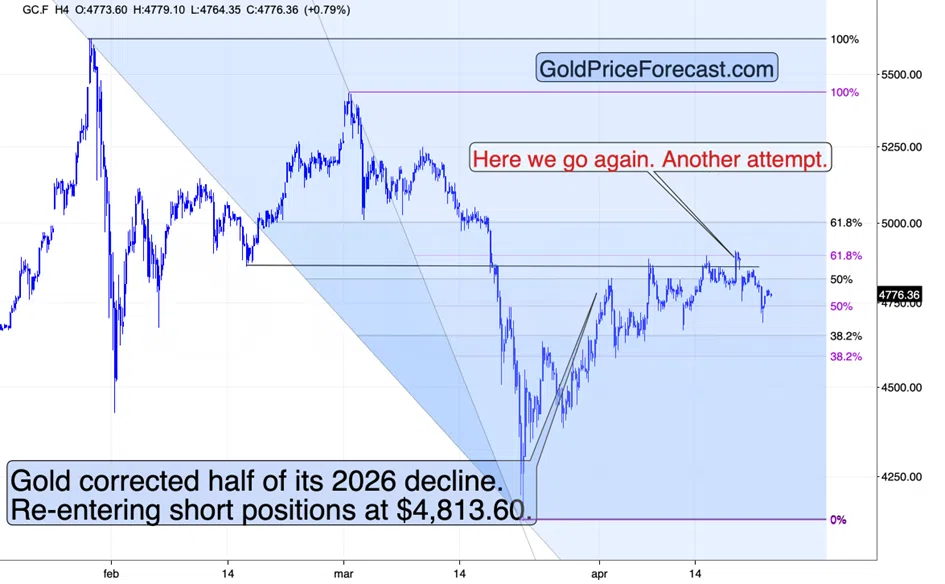
Remember yesterday’s quick note? Gold declined shortly thereafter.
In yesterday’s Gold Trading Alert, I wrote the
following on gold and silver:
“Not much new to report besides the fact that gold is back
below the 50% retracement, the $4,800 level, and back below the
level at which I wrote about re-entering short positions.
It looks like the corrective rebound is over or very close to being over.
Same with silver. The white precious metal had its brief moment
of strength and now it’s declining more than gold.
Please note that silver corrected less than gold on a relative
basis despite its industrial component which one would expect to
drive silver higher given the rally in stocks. This did NOT
happen, suggesting that silver is headed lower in the following weeks.”
Both precious metals declined. They both moved to new weekly
lows, and silver additionally broke below its rising short-term support line.
The decline in the GDXJ was even more profound.
The GDXJ declined by almost 7%, and it closed very close to the
lowest April daily closes. From monthly high to almost monthly low
in just two sessions – this tells you how quickly GDXJ can
decline when it finally decides to move.
Quoting my previous comments:
“Namely, the GDXJ hit its 61.8% Fibonacci retracement and
its rising resistance line, before declining right before
Friday’s closing bell.
Not only have we seen two resistance levels being reached, but we
also was an intraday reversal candlestick (so called gravestone
doji candlestick). All those signs suggest that the rally is quite likely
over.”
And you know what? It’s not only the technicals that support
lower prices in the following weeks – so do the fundamentals.
The Ceasefire That Isn’t
Let me lay out what happened during this “ceasefire” in the past
week alone.
IRGC gunboats fired on two tankers on Saturday. Two Indian-flagged
ships were targeted and forced to turn back. A container ship took
rocket damage off Oman.
The US Navy fired on and seized the Iranian cargo ship Touska on
Sunday, blowing a hole in its engine room.
Iran retaliated by firing drones at US Navy warships. No damage was
reported, but this is a direct military engagement between the two
sides during a supposed ceasefire.
The US submarine USS Charlotte sank the Iranian Navy frigate IRIS
Dena in the Indian Ocean near Sri Lanka. The ship was returning from
an international naval exercise in India and was reportedly carrying
no ammunition. 104 Iranians were killed, 32 injured. This was the
first submarine sinking of a warship in active combat since the
Falklands War in 1982.
The US boarded the sanctioned tanker M/T Tifani in the Indian Ocean
between Sri Lanka and Indonesia. Trump said the military intercepted
a “gift from China” to Iran.
And today, two more ships fired on near the Strait.
This is not a ceasefire. This is active naval warfare with a press
release calling it something else. The distinction matters for gold
but not for oil.
Why This is Worse for Gold Than Active War
The market has figured out something that most commentary is
missing. From a supply disruption standpoint, the frozen conflict is
functionally identical to active war. The Strait is at 5-16% of
normal capacity. Ships are being shot at. Kuwait declared force
majeure on all crude oil and refined product shipments. Iran’s Kharg
Island storage is filling up. 13 million barrels per day of
production remains shut in. Half a billion barrels of cumulative
supply have been lost.
Oil doesn’t care whether the disruption comes from bombs or from
IRGC gunboats and a permanent blockade. The supply is gone either
way.
The dollar doesn’t care either. The US is the world’s largest oil
producer. High oil from Strait disruption hurts Europe (6 weeks of
jet fuel left), Asia (largest importers of Gulf crude), and
developing countries (fuel rationing in Philippines, Nigeria,
Pakistan) more than it hurts the US. Capital flows to where the pain
is lowest. That’s America. The dollar strengthens not on acute panic
but on the structural widening of the economic gap between the US
and everyone else. That’s a more durable form of dollar strength
than a safe-haven spike.
Gold is different. Gold needs acute fear. Bombs falling, escalation risk, “civilization will die tonight”
rhetoric. That generates the spikes. A chronic standoff with ships
being shot at, but no dramatic headlines about infrastructure
strikes doesn’t produce the same safe-haven demand. The geopolitical
premium drains out slowly. Meanwhile, all the structural headwinds
remain: oil elevated → inflation sticky → Fed frozen
→ dollar strong.
Gold gets the worst of both worlds. The structural pressure stays
(oil, inflation, dollar). The offsetting safe-haven bid fades (no
acute crisis, just chronic standoff).
Gold declined yesterday. If peak tension couldn’t hold gold up, the
removal of that tension (via the indefinite extension) won’t either.
Today’s 1.15% bounce is an emotional relief after yesterday’s
selloff. It doesn’t change the direction.
Thank you for reading today’s article – the free version of
today’s Gold Trading Alert (in which the analysis continues).
Subscribers receive the full analysis with charts, technical levels,
and trading positions daily. Gold Trading Alerts are available directly and through the
Diamond Package.
Thank you.
Sincerely,
Przemyslaw K. Radomski, CFA
Investorideas.com
is the go-to platform for big investing ideas. From breaking stock
news to top-rated investing podcasts, we cover it all.
Mining stocks -Learn more about our news, PR and social media,
podcast and content services at Investorideas.com
