

Another disappointing result for DIY corporate financiers this week. Having hosted the ‘Fair Sale’ over itself nearly two years ago, Residential Secure Income (LSE: RESI) has announced that most of its assets are set to be acquired by the Social Housing REIT (LSE: SOHO).
SOHO will get RESI’s retirement home portfolio, with the rump of RESI’s assets going to a currently unnamed bidder.
The mostly paper-based deal values RESI at about 57p per share, depending on movements in SOHO’s share price.
There are a few moving parts to the deal. But the point to note is that RESI was priced at about 60p a share in October 2024 when it first announced it was winding itself down. Hence this has hardly been a barnstorming return for anyone who bought into the REIT in hopes of unlocking value.
Moreover, RESI’s tangible NAV was nearer 80p in late 2024, compared to c.63p at the last count. RESI did sell a different chunk of its portfolio in early 2025, but that all went on debt repayment.
So its managers have presided over a shrinking asset base that’s ultimately been sold at a still-meaningful discount to NAV.
The total return situation isn’t quite as dispiriting. RESI yields over 7%, so when you take dividends into account investors were at least paid to wait for their mediocre outcome.
RESI’s managers would no doubt stress too that shareholders who keep their SOHO shares after the sale completes will retain ongoing exposure to RESI’s attractive (and discounted) assets, via the newly enlarged parent.
But still, this is hardly the sort of outcome that Joel Greenblatt touted in his classic book You Can Be A Stock Market Genius, when he explained how ordinary investors can profit from corporate activity in the public markets.
REIT petite
I wrote about the opportunity in RESI for Moguls in January 2025. In the same post I also highlighted that Abrdn European Logistics Income (LSE: ASLI) was on the block, too.
The ASLI outcome was a bit better. Shareholders should eventually get around a 20% return from memory, once the protracted endgame is over.
(Surely we can also all rejoice any time an instance of the dreaded moniker ‘Abrdn’ is put out of its misery!)
But again, the ASLI wind-down did not release vast swathes of value. And that has been the trend with this REIT consolidation that began after the yield-driven rout of 2022.
Cut-price deals: everything must go
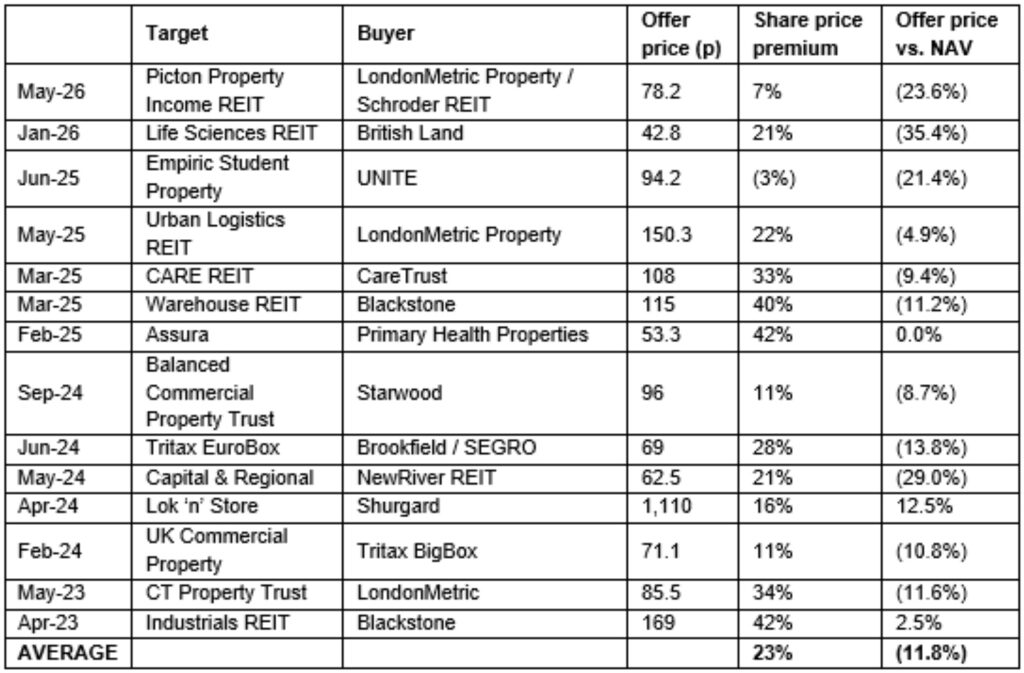
A.J. Bell recently published a handy roundup of all this REIT sales and merger activity, and the premiums – or otherwise – achieved:
Source: Company accounts / A.J. Bell
Note: Negative moves/premiums in brackets.
While these actions spurred some worthwhile-ish share price pops, they have nearly all seen assets taken out at a big discount to NAV. Which I suppose isn’t surprising in hindsight, given the huge discounts that even the largest and most liquid UK REITs still trade on.
This suggests two things.
Firstly, there are not many buyers for these property assets – either from the public or private domains.
Secondly, neither the market nor the companies themselves consider these commercial property NAVs as anything like gilt-edged. They are more, as the pirate’s code puts it, guidelines.
Clearly, fears and uncertainties still abound – six years after Covid plunged the future of commercial property into doubt, three years after interest rate rises did a number on the economics, and a couple of years into A.I. making everyone nervous about what the future of humans at work really looks like anyway.
The REIT stuff
When a sector is this unloved, it’s hard to remember it wasn’t always so. But the real estate sector’s status as stock market booby prize isn’t a law of nature.
Throughout the 1990s and the early 2000s, property was lauded as a halfway house between bonds and equities.
The pitch? You got the attractive income of bonds and some of the capital gains of shares, with a dose of inflation-hedging thrown into the mix, too. Back then even passive investors saw the value of adding REIT exposure to their portfolios. They hoped for a bit of lower-risk additional diversification.
Property developers thrived as much as the steadier landlords. Money was cheap, and as global capital searched for more touchy-feely returns following the Dotcom crash, prestige skyscrapers began to sprout across the world’s major cities, minting millions.
It’s hard to believe nowadays, but many UK REITs and blue chip property developers actually used to trade at a premium to NAV!
Confident investors anticipated valuation gains and higher incomes, and they were happy to front run them.
Bargain buildings
That all ended with the financial crisis, however, and the asset class has never recovered. Big discounts to NAV for commercial property REITs abound.
Here’s how the UK bellwethers trade compared to their assets:
CompanyMarket capPrice / NAVDiscountSegro (LSE: SGRO)£10bn744p / 925p(20%)Land Securities (LSE: BLND)£4.7bn629p / 882p(29%)LondonMetric (LSE: LMP)£4.3bn182p / 201p(9%)British Land (LSE: BLND)£4.1bn 401p / 590p(32%)
Source: Company reports / Prices as of 18 June 2026
Imagine walking around town and seeing giant 30%-off labels slapped across the frontages of office blocks and shopping centres. That’s effectively what you get with most REITs – large and small – today. £10 of assets on sale for £7 or less.
LondonMetric – which has driven much of the sector consolidation that we began with – is on a narrower discount, true. Partly that’s thanks to its stronger balance sheet and tighter terms with tenants.
But I’d also argue LondonMetric has won investors over by telling a better story. That’s what the rest of the REITs need to do. (And ideally for it to be true, of course!)
REIT-sizing exposure
Even my co-blogger, The Accumulator, gave me stick about REITs the other day.
Apparently I’d persuaded TA that he should keep them in our Slow & Steady portfolio when he soured on the asset class.
It was a few years ago, but he hadn’t forgotten!
TA’s disenchantment with REITs will be driven more by revisiting the historical record than by the sector’s recent travails. All the same, if REITs were multi-bagging like semiconductor stocks I wonder if there’d be quite so much soul-searching?
Equally, I think I suggested we retain them more due to my bias against fussing too much with a model portfolio than out of conviction that the asset class was cheap.
Still, maybe this is another signal?
Most things in investing are cyclical. When even diehard passive investors are ready to throw in the towel, perhaps the bottom is near.
Most of the major REITs have been doing a lot better of late. Rents are up, and even office valuations are stabilising, if not rising. Albeit more for the top-end stuff.
The surviving players have navigated a once-in-a-generation interest rate shock, too.
Real estate investment vehicles invariably carry a lot of debt. So when interest rates spiked it not only made their dividend payouts relatively less attractive and pressured their tenants – it also stressed their own balance sheets.
The past three years saw debts refinanced and restructured though, and to my mind the big REITs now look pretty solid. They’ve even begun to invest in new developments.
Improving cashflows underpin generous dividend yields of 4-7% for the REITs in my table. I’d say that’s attractive, given there’s an inherent ability to respond to inflation (compared to vanilla bonds) and the prospect – eventually – of more capital growth.
Priced for imperfection
While I might keep my shares in SOHO when the RESI deal completes, I think I’m more inclined to look at the stronger REITs than to punt again on the little guys being taken over.
With hindsight, it was optimistic to expect the smaller prey to get acquired at close to NAV when the big predators themselves were still badly limping.
Sector consolidation was necessary – too many sub-scale REITs were launched in the near-zero interest rate era. But investors aren’t being rewarded for the extra risks.
In contrast, the big REITs will hopefully see continued strong dividends and eventually some more share price growth. And there’s the prospect of a double-whammy gain if property valuations increase even as discounts narrow to meet those rising NAVs.
Of course, there are risks – everything from the sorry state of the UK economy and politics to the need to upgrade old offices to comply with environmental standards to AI threatening to send white-collar workers to not-work-from-home forever.
But the discounts likely reflect a lot of these dangers, given the underlying metrics are now improving. And to the upside, with oil flows set to resume through Hormuz and inflation risks hopefully contained, we might eventually even see more interest rate cuts.
That’d really help refurbish the appeal of property. Just ask Donald Trump!
