

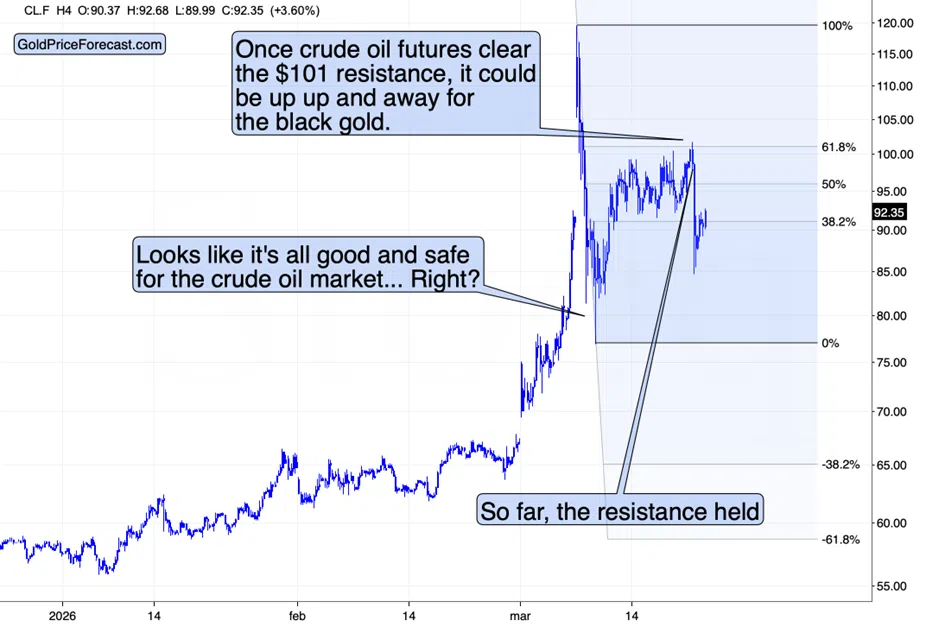
Technicals are just as they were yesterday – everything that I wrote yesterday remains up-to-date.
In today’s Gold-Trading-Alert-based free analysis (I only
removed some technical details and the positions/targets),
therefore, I’d like to update you on something else. On the
WHY behind the recent price moves. This will also help to explain
why technicals make sense right now. It’s usually the case
that I’m focusing on technicals and let them guide me, but in
this case, what we see on the fundamental front aligns with the
above, so I thought it would be worth sharing.
Trump’s “Productive Talks” and the Five-Day Illusion
Monday’s market reaction was dramatic. After threatening over the
weekend to “obliterate” Iran’s power plants if the Strait of Hormuz
wasn’t reopened within 48 hours, President Trump posted on Truth
Social that the U.S. and Iran have had “very good and productive
conversations regarding a complete and total resolution of our
hostilities in the Middle East.” He postponed the strikes for five
days.
Stocks soared and invalidated their breakdown. The Dow jumped 631
points. The S&P 500 gained 1.15%. Brent crude ultimately dropped
11% to settle below $100 for the first time since March 11. WTI sank
over 10% to $88.
Gold and silver initially crashed along with a small rally in crude
oil. Then, when oil crashed, gold and silver rallied back up. The USD Index dipped about 0.5%.
That intraday sequence is telling, and it confirms the dynamic
that’s been in place throughout this war. Gold is trading inversely to crude oil through the inflation/rate
expectations channel. Higher oil means more inflation, which means
the Fed holds rates higher for longer (or even hikes), which makes
zero-yield assets like gold and silver less appealing. Lower oil
means less inflation pressure, which means rate cuts become possible
again, which lifts precious metals. This relationship hasn’t
changed. It held again yesterday.
The implications for what comes next are profound. If oil rallies
again toward $100+ (which I think happens within days for reasons
I’ll explain below), gold faces renewed selling pressure from the
rates side. The current bounce in precious metals is a function of
oil dropping. When oil stops dropping, the bounce stops too.
Interestingly, I sent yesterday’s Gold Trading Alert while gold had
only started recovering, correctly expecting the rebound based on
technical grounds before the oil crash provided the
catalyst. It’s remarkable how technicals can lead real-world events, and yet that’s exactly what we see time and
time again. The charts were already signaling that the selloff was
overextended and a bounce was due. The fundamental justification for
the move arrived later.
The market read Trump’s announcement as a de-escalation
signal. I think the market is wrong.
Here’s why.
Iran Says There Are No Talks
Hours after Trump’s announcement, Iran’s foreign ministry issued a
flat denial. Tehran said there had been “no dialogue” between Iran
and the United States during the entire 24 days of the war. Iran’s
state television network said Trump had “withdrawn his 48-hour
ultimatum out of fear of Iran’s response.”
A senior Iranian foreign ministry official later told CBS News that
Iran “received points from the U.S. through mediators and they are
being reviewed.” That’s diplomatic language for “someone passed us a
note.” It is not “very good and productive conversations regarding a
complete and total resolution.”
Trump later elaborated, saying his son-in-law Jared Kushner and
envoy Steve Witkoff spoke Sunday evening with “a top person” in
Iran. He did not identify this person. He said the two sides have
“major points of agreement, I would say, almost all points of
agreement,” including that Iran will “never have a nuclear weapon.”
For context: less than 48 hours before this statement, Trump said
publicly, “We’re having a hard time. We want to talk to them, and
there’s nobody to talk to.” He then added: “We have nobody to talk
to, and you know what? We like it that way.”
Those two statements, made 48 hours apart, tell you everything about
how to interpret what Trump says about Iran.
Understanding Trump’s Psychological Operating System
To understand what’s happening here, you need to understand how
Trump processes events. I’ve studied this extensively over the past
year for purposes of anticipating market-moving decisions, drawing
on his own writings, psychological analyses by experts at
Northwestern University, and the testimony of people who worked
closest to him.
The most important insight comes from psychologist Dan McAdams, who
concluded that Trump is what he calls “the episodic man.” Unlike
most adults, who construct a coherent narrative connecting their
past, present, and future decisions, Trump lives in disconnected
episodes. Each moment is a discrete battle to be won. What he said
yesterday doesn’t constrain what he says today. What is “true” for
Trump is what works to win the current episode.
This is not a character flaw that prevents him from governing. It’s
his operating system. And it’s remarkably consistent.
His own book, “The Art of the Deal,” makes the strategy explicit: “I
aim very high, and then I just keep pushing and pushing to get what
I’m after. Sometimes I settle for less than I sought, but in most
cases I still end up with what I want.” He calls this approach
“truthful hyperbole.”
Applied to the Iran situation, the pattern is now repeating for the
third time in this war alone:
On March 9 (day 10), Trump said the war would be over “very soon.”
Oil dropped. Stocks rallied. Then the war intensified, oil surged
back above $100, and stocks gave back all the gains.
On March 21 (day 22), Trump posted that the U.S. was “getting very
close to meeting our objectives as we consider winding down our
great Military efforts.” Oil dipped. Stocks bounced. Within 24
hours, he issued the 48-hour power plant ultimatum, the most
escalatory threat of the entire war. Oil spiked higher.
On March 23 (day 24), Trump announced “productive talks” and a
five-day postponement. Oil dropped 11%. Stocks surged. And here we
are.
The episodic pattern is identical each time: escalatory threat,
followed by face-saving retreat dressed as progress, followed by
market relief, followed by reality reasserting itself when the
underlying conflict hasn’t changed.
The confrontation rhetoric establishes maximum credibility, and then
the retreat is packaged as a “win.” It worked perfectly in tariff
negotiations last year because Trump controlled both sides of the
equation. He could escalate and de-escalate unilaterally.
But here’s the problem: war is not a tariff negotiation.
Why the Relief Rally Won’t Last
There are three reasons the current market bounce is likely
temporary.
First, Iran has independent agency. Trump can postpone his own
strikes. He cannot stop Iran from continuing to threaten shipping in
the Strait. He cannot stop Iran from firing drones at Gulf
infrastructure. And Iran’s stated position has not changed: it
demands a full ceasefire, guarantees that the war won’t resume, and
compensation for damages. Trump’s stated demands (zero enrichment,
complete nuclear facility destruction, full missile program halt)
are incompatible with Iran’s position. The gap between these
positions cannot be bridged in five days. It is not even close.
Second, Israel has its own agenda. This is the critical variable
that most market participants are underweighting. Israeli Defense
Minister Israel Katz directly contradicted Trump’s “winding down”
message over the weekend, saying Israeli forces would “significantly
increase the intensity of the strikes.” Israel continued striking
Tehran on Monday, even as Trump was announcing “productive talks.”
Israel is simultaneously invading Lebanon, hitting more than 200
targets over the weekend, and planning full seizure of territory
south of the Litani River. One senior Israeli official told Axios:
“We are going to do what we did in Gaza.” Three Trump advisers told
Axios: “Israel doesn’t hate the chaos. We do.”
In tariff negotiations, there was no allied party with its own
maximalist objectives that Trump couldn’t control. Netanyahu wants
the permanent destruction of Iran as a regional military power. That
objective takes months, not days. Every Israeli strike gives Iran
motivation to keep retaliating across the Gulf.
Third, Iran’s asymmetric capability remains largely intact. Prewar
estimates put Iran’s drone stockpile at several thousand to well
above 10,000 units (some wrote about 80,000). Iran has launched over
2,000 drones since February 28 (and who knows how many were
produced), but a senior fellow at the Stimson Center noted that the
90% decline in launch rates may reflect “tactical recalibration”
rather than degraded capacity. The Shahed-136 drone costs as little
as $4,000 to produce, requires no fixed infrastructure (it launches
from a pickup truck), and can’t be targeted by the conventional
airstrikes that have destroyed Iran’s navy and air force. In Yemen,
over 900 U.S. and UK airstrikes failed to suppress Shahed-derived
systems because they are dispersed, mobile, and difficult to locate.
Iran doesn’t need ballistic missiles to keep the Strait disrupted.
It needs pickup trucks and $4,000 drones.
Oil Will Likely Rally Again, and Everything Else Will Follow
The correlation structure of the past three weeks has been
straightforward: when oil surges, stocks fall, gold falls (due to
inflation/rate fears), and the USD rises. When oil drops, the
reverse happens.
Monday’s moves fit this pattern perfectly. Oil dropped 11%. Stocks
rallied. Gold rallied back up after its initial plunge (tracking the
oil crash, not the stock rally). The USD dipped.
But already on Tuesday morning, oil is climbing back. Iran denied
talks. Israel kept striking. The IEA’s assessment that 40+ energy
facilities across nine countries are “severely damaged” hasn’t
changed. The Strait of Hormuz remains effectively closed to
unescorted commercial traffic.
In five days, Trump faces the same binary he faced on Monday: follow
through on the power plant threat (which would send oil to $130-150
and fully close the Strait), or postpone again (which Iran will
frame as another retreat). Given his documented preference for
face-saving retreats over catastrophic escalation, I think he postpones again. But each postponement erodes the
credibility of the threat while oil stays elevated because the
Strait remains disrupted.
The structural oil picture won’t normalize quickly even in a
best-case ceasefire scenario. Forty-plus damaged energy facilities
take months to repair. Maritime insurance companies don’t re-cover
Gulf shipping because a president posted on Truth Social. Supply
chains that have been disrupted for a month don’t restart overnight.
The IEA head said Monday that this crisis is worse than the 1970s
oil shocks combined, with global supply reduced by approximately 11
million barrels per day.
This means oil likely settles in the $90-110 range for weeks to
months, with spikes higher on any re-escalation. And the next
re-escalation trigger is already visible on the calendar: Trump’s
own five-day deadline expires on Friday, March 28.
Remember that the triangle-vertex-based reversals on several markets point to a reversal close to the end of the
month?
The Current Upswing in Gold, Silver, and Mining Stocks Is Corrective
Gold fell nine straight sessions before Monday, losing nearly 10% in
a single week. Silver fell by over 10%. Mining stocks got crushed
alongside both metals and the broader equity market. Monday’s rally
in gold and silver, driven by the oil crash, looks like a natural
correction after extreme oversold conditions, not a change in trend.
The dominant force in precious metals right now is not safe-haven
demand. It’s the inflationary impact of sustained high oil prices on central bank policy. The Fed
held rates at 3.50-3.75% at its March 18 meeting and signaled at
most one rate cut remaining for 2026. Core PCE has re-accelerated to
3.1%. One major broker, Macquarie, now projects the Fed’s next move
will be a rate HIKE, not a cut. The Bank of England and ECB are
facing similar pressures.
When interest rates rise globally because of an oil-driven inflation shock,
zero-yield assets like gold face intense headwinds. That’s what
drove gold’s worst week since 1983. It’s the same force that hit
gold in early 2022 when the Fed began its hiking cycle.
Analyst Arthur Parish of SP Angel identified the deeper dynamic at
work: the gold rally of 2025 (up 66%) attracted “tourists” into the
market. Generalist funds, systematic hedge funds, retail momentum
chasers. That money “is not wedded to long-term gold positioning”
and is now leaving. The central bank buying that drove the
structural bull market continues, but the leveraged paper positions
are being flushed.
This flush isn’t complete. When oil rallies again (which I think
happens within days as the five-day deadline approaches and the
Strait remains disrupted), the inflation/rates narrative reasserts
itself, and gold faces renewed selling pressure. The corrective
bounce we might see this week is a selling opportunity, not the
start of a new leg higher.
Silver faces even greater vulnerability because of its dual
exposure: it gets hit by inflation fears (like gold) AND by industrial demand fears (like copper). In
an environment where oil at $90-110 threatens global growth,
silver’s industrial demand component becomes a liability.
Mining stocks amplify these moves, as they always do. GDXJ and
similar vehicles fall faster than gold during declines and bounce
faster during recoveries. The Monday/Tuesday bounce in mining stocks
is technically normal after extreme selling. It doesn’t change the
downward pressure from higher real yields, compressed margins from
energy costs, and the broader equity market’s gravitational pull
lower.
The USD Dip Is Temporary
The USD Index fell 0.5% on Monday as risk appetite returned. This
looks like a mirror image of the oil-driven moves: when oil drops
and stocks rally, the safe-haven bid for dollars weakens. When oil
resumes its climb and stocks resume falling, the USD strengthens
again.
The broader picture supports further USD strength from here. The Fed
is the most hawkish major central bank right now. The 3.50-3.75%
rate, with no cuts coming, maintains a significant yield advantage
over Europe (where the ECB has been cutting) and Japan. Every day
that oil stays elevated reinforces the Fed’s reluctance to ease,
which supports the dollar through interest rate differentials.
From Trump’s perspective, a strong dollar creates a political
problem (more expensive exports, which conflicts with his
manufacturing agenda), but the alternative, cutting rates while
inflation accelerates from the oil shock, would be far worse for
consumer sentiment. The Fed’s independence, despite Trump’s
documented frustration with it, is doing the dollar a favor right
now.
The Five-Day Countdown
The next inflection point is Friday, March 28. That’s when Trump’s
postponement expires. Between now and then, the market will
oscillate between hope (that “productive talks” produce results) and
reality (that Iran denies talks exist, Israel keeps striking, and
the Strait remains closed).
My base case: Trump extends the deadline again. He finds another
formulation that lets him claim progress without actually bombing
power plants. The war enters a lower-intensity phase in April, but
oil stays elevated or even rallies further because the Strait
remains dangerous and damaged infrastructure takes months to
repair. Both are detrimental to the economy and stock market
values.
The market implication is that the current bounce is a selling
opportunity. When the five-day window closes without a resolution,
oil likely tests $100+ again, stocks resume their decline, gold and
silver face renewed pressure from inflation/rate fears, and the USD
strengthens.
The broader direction hasn’t changed. Oil is the dominant variable,
and oil isn’t going back to $70 anytime soon. Everything else
follows from that.
As always, I’ll keep my subscribers informed.
My Gold Trading Alerts are currently available to you at a VERY
preferred price – check it out, you’ll like it, and timing couldn’t be
better.
Thank you.
Sincerely,
Przemyslaw K. Radomski, CFA
Investorideas.com
is the go-to platform for big investing ideas. From breaking stock
news to top-rated investing podcasts, we cover it all.
Mining stocks -Learn more about our news, PR and social media,
podcast and content services at Investorideas.com
