

(Investorideas.com
Newswire) a go-to platform for big investing ideas, including gold and
energy stocks issues market commentary from deVere.
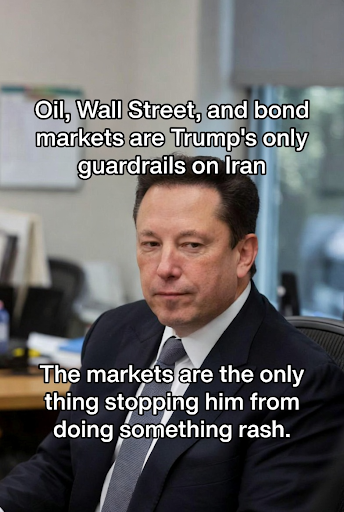
Oil, Wall Street, and bond markets are the only forces capable of
President Trump restraining escalation in the Iran conflict, with
financial pressure increasingly shaping the direction of US policy,
warns the CEO of one of the world’s largest independent
financial advisory organizations.
The comments from Nigel Green of deVere Group come after several weeks of market turbulence linked directly
to the war, during which oil prices have surged above $100 a barrel,
the S&P 500 has endured sustained losses, and US Treasury yields
have climbed sharply as investors reassess inflation and fiscal
risks.
On February 28, Brent crude was trading below $95 a barrel, and the
10-year US Treasury yield sat at 3.96%. By March 21, as strikes
intensified and fears grew over disruption through the Strait of
Hormuz, oil had surged through $105 and yields had pushed above
4.3%, while the S&P 500 had fallen for four consecutive weeks.
The pressure point came days later. Between March 21 and March 23,
oil spiked toward $107, equity markets extended losses, and Treasury
auctions during that same week drew weaker demand, pushing yields
higher still.
On March 23, the US announced a temporary five-day pause on strikes
targeting Iranian energy infrastructure.
The market reaction was immediate. On March 24, oil prices dropped
sharply, falling close to 10% from their peak.
The S&P 500 rebounded strongly in the same session, while
Treasury yields eased back from recent highs. The sequence was
clear: escalation drove stress across all three indicators;
restraint followed.
He says, “Three indicators are now acting as real-time guardrails on
policy: oil prices, equity markets, and Treasury yields.
They’re sending signals to Trump he cannot ignore.”
“Each time the conflict intensifies, oil spikes, stocks fall,
and yields rise. Each time there is even a hint of restraint, those
moves reverse. The pattern now seems firmly established.”
Energy markets have been the most immediate transmission channel.
Disruption fears around key shipping routes and infrastructure have
driven crude prices into triple digits in recent weeks, feeding
directly into inflation expectations and consumer costs.
“Oil is the fastest pressure point. Higher energy prices hit
households almost immediately. This creates political and economic
pressure that builds very quickly.”
He adds: “We’ve already seen how sensitive
decision-making is to this. When oil surged aggressively, there was
a clear shift in tone and action. Markets forced a response.”
Stock markets have reinforced that message. The S&P 500 has
recorded multiple weeks of losses since the conflict intensified,
with declines closely tied to escalation points and rebounds
following signals of de-escalation.
The deVere CEO says: “Wall Street is acting as a barometer of
confidence. Sustained declines tighten financial conditions, weaken
sentiment, and raise the stakes for policymakers.
“Sharp sell-offs are not just market noise. They reflect
growing concern about the economic consequences of prolonged
conflict. This feeds directly into the broader outlook.”
The bond market, however, represents the most structurally
significant constraint. Treasury yields have moved higher in recent
weeks, driven by a combination of inflation fears, heavy issuance,
and signs of weaker demand at auctions.
“Rising yields are a critical warning sign. They increase the
cost of financing an already enormous debt burden and ripple through
the entire economy via mortgages and corporate borrowing.
“With US debt above $39 trillion, the sensitivity to higher yields
is far greater than in previous cycles. The margin for
error is much smaller,” he explains.
Volatility in the Treasury market has also intensified, with
liquidity conditions deteriorating during periods of stress. This
has raised concerns about how easily the US can continue to fund
large deficits if demand becomes less reliable.
“The assumption that demand for US debt will always absorb
whatever is issued is being tested. If that assumption weakens, the
implications are significant.
“Higher yields, weaker demand, and elevated volatility combine to
create a powerful constraint. It is one of the few forces that can
genuinely influence the trajectory of policy.”
Nigel Green continues: “Taken together, these three variables
form a clear framework. Oil reflects immediate inflation and
consumer pressure. Wall Street signals confidence and financial
conditions. And Treasury yields determine the sustainability of
government financing.
“Escalation drives all three in a negative direction. Even
limited de-escalation produces an immediate stabilization.”
Research oil and gas stocks at Investorideas.com free stock
directory
https://www.investorideas.com/OGSN/stock_list.asp
Research Natural gas and helium stocks at
Investorideas.com
https://www.investorideas.com/Companies/NaturalGas/Stock_List.asp
Investorideas.com
is the go-to platform for big investing ideas. From breaking stock
news to top-rated investing podcasts, we cover it all. Our original
branded content includes podcasts such as Exploring Mining, Cleantech,
Crypto Corner, Cannabis News, and the AI Eye. We also create free
investor stock directories for sectors including mining, crypto,
renewable energy, gaming, biotech, tech, sports and more. Public
companies within the sectors we cover can use our news publishing and
content creation services to help tell their story to interested
investors. Paid content is always disclosed.
Learn more about our news, PR and social media, podcast and content
services at Investorideas.com
