

(Investorideas.com
Newswire) a go-to platform for big investing ideas, including energy
stocks issues market commentary from deVere Group.
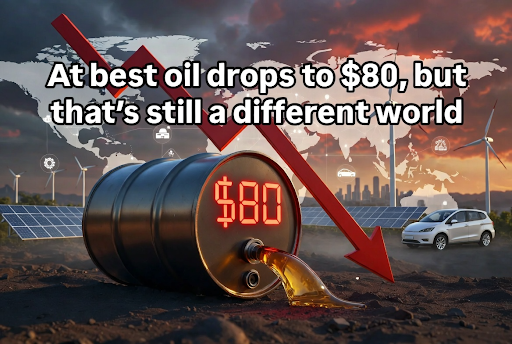
At best, oil drops to $80, but that’s “a different
world” to what we had before the US-Iran war, predicts the CEO
of one of the world’s largest independent financial advisory
and asset management organizations.
The stark prediction from Nigel Green of deVere Group, which has $14 billion under advisement, comes as Brent crude
surged beyond $120 a barrel to a new conflict era high this week
following a US-led blockade of the Strait of Hormuz, a maritime
corridor that carries close to 21 million barrels per
day—around a fifth of global oil consumption.
Nigel Green says: “Even if oil pulls back to $80, I suspect
that markets aren’t going back to the conditions seen when
crude traded at $60 earlier this year.
“A structural reset has taken place, and it’s being
driven by deliberate major global political strategy on several
fronts, not just supply disruption.”
Prices have climbed sharply from roughly $60 in January to above
$100 before the latest escalation, with the move through $120
reflecting both physical risk to supply and a surge in geopolitical
premium. Shipping costs through the Gulf have jumped, with war risk
insurance reportedly rising several-fold in recent weeks, while
rerouting adds time and cost to global deliveries.
“Moving forward, the Strait of Hormuz can no longer be treated
as a neutral passage.
“Around 20% of the world’s oil and a significant share
of LNG flows pass through it. Interference at that scale forces a
complete repricing of risk across energy markets.”
Donald Trump is using the blockade as leverage in its confrontation
with Iran, embedding energy supply directly into geopolitical
negotiations.
A temporary ceasefire announced weeks ago has done little to restore
confidence in uninterrupted flows.
Nigel Green explains: “Oil is now part of the negotiating
toolkit, which changes everything. Prices are no longer reacting
only to events; they’re reflecting intent.
“This introduces a persistent premium, which will, we expect,
keep a floor under the market.
“A fall back to $80 would still leave oil roughly 30% above
levels seen at the start of the year. For the global economy, that
carries immediate consequences.”
The International Energy Agency estimates that every sustained $10
increase in oil prices adds around 0.2 percentage points to global
inflation, feeding directly into transport, food, and manufacturing
costs.
“Even an $80 oil price still feeds inflation at a level
central banks can’t ignore. It tightens financial conditions,
squeezes consumers, and forces policymakers to hold restrictive
settings for longer than markets had expected,” notes the
deVere CEO.
The growth outlook is also shifting. Higher fuel costs are already
filtering through supply chains, raising input costs for industry
and compressing margins. Import-dependent economies such as China,
Japan, and much of Europe face a heavier burden, while US producers
benefit from domestic output strength.
“Energy-importing economies are exposed in a way that becomes
immediately visible in trade balances and corporate earnings. This
is a material headwind.”
Global spare production capacity, largely concentrated within OPEC+,
remains limited relative to potential disruption scenarios.
Nigel Green says: “There is no quick fix on the supply side.
Spare capacity exists, but it is not sufficient to neutralize a
prolonged disruption of this scale. That reality reinforces the
higher floor for prices.”
Financial markets, which had been positioned for easing inflation
and improving growth conditions, are being forced to adjust rapidly.
Energy equities have outperformed, while sectors reliant on
transport and logistics are under pressure.
The repricing is already happening. Energy producers, commodities,
and assets with strong pricing power are gaining support. Sectors
with thin margins are being tested hard.
The broader shift extends beyond oil. Strategic use of trade routes,
sanctions, and supply chains is becoming more pronounced across
global geopolitics, increasing the speed at which political
decisions feed into market pricing.
Governments are responding by accelerating energy security
strategies, including stockpiling, diversification of suppliers, and
increased investment into domestic production and alternative energy
sources.
Nigel Green concludes: “A drop to $80 will be presented as a
stabilization point, but it’s a fundamentally different
pricing world.
“The era of assuming stable, uninterrupted energy flows has
ended. Oil is now part of geopolitical leverage, and that shift is
setting a higher and more persistent floor under the market.”
Research oil and gas stocks at Investorideas.com’s free stock
directory
https://www.investorideas.com/OGSN/stock_list.asp
Research Natural gas and helium stocks at
Investorideas.com
https://www.investorideas.com/Companies/NaturalGas/Stock_List.asp
Investorideas.com
is the go-to platform for big investing ideas. From breaking stock
news to top-rated investing podcasts, we cover it all. Our original
branded content includes podcasts such as Exploring Mining, Cleantech,
Crypto Corner, Cannabis News, and the AI Eye. We also create free
investor stock directories for sectors including mining, crypto,
renewable energy, gaming, biotech, tech, sports and more. Public
companies within the sectors we cover can use our news publishing and
content creation services to help tell their story to interested
investors. Paid content is always disclosed.
Learn more about our news, PR and social media, podcast and content
services at Investorideas.com
