

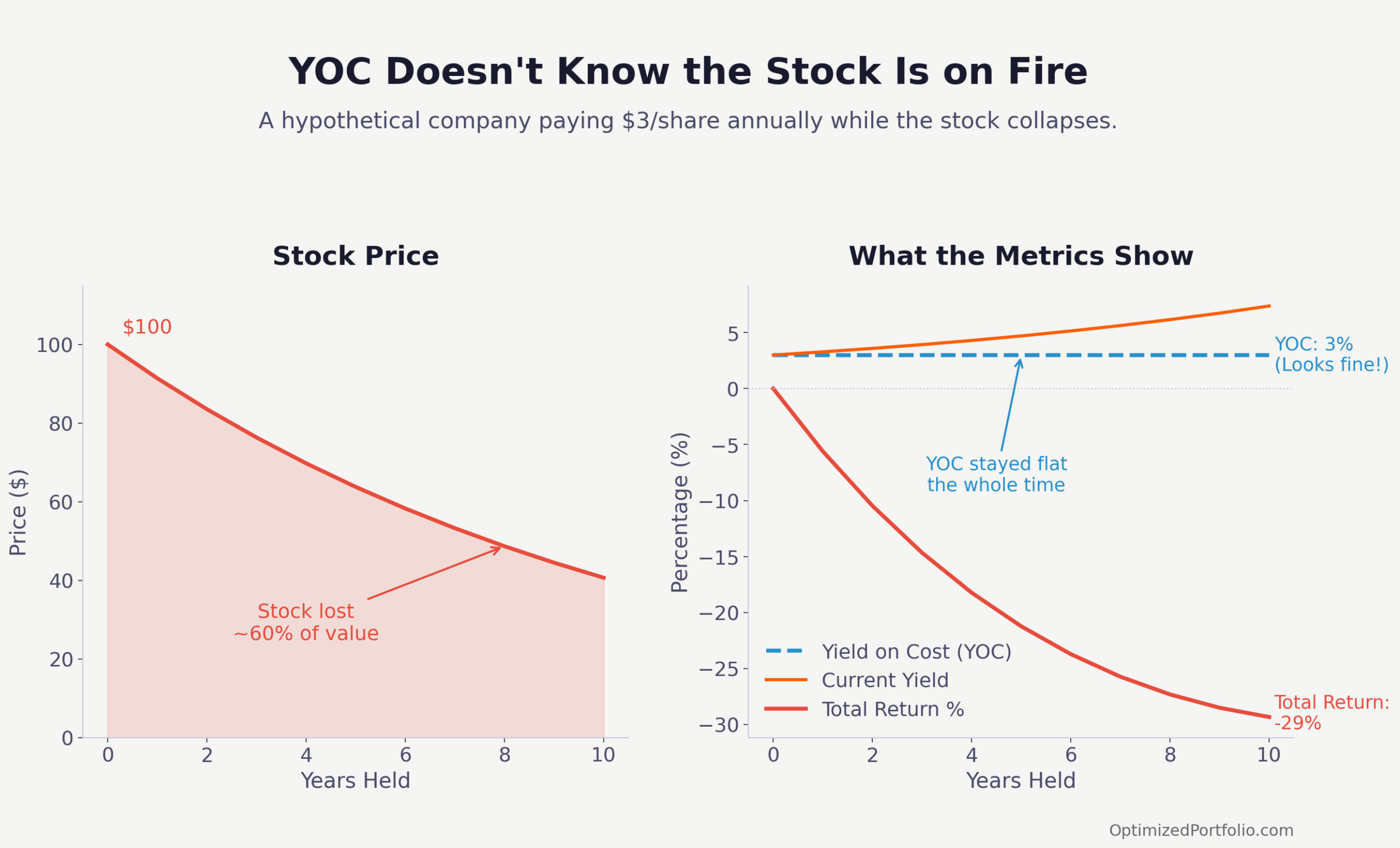
Yield on Cost keeps showing up on my radar. Here I’ll explain why this popular metric that dividend investors love is actually pretty meaningless and why it has been called “the most irrelevant metric in investing.”
Disclosure: Some of the links on this page are referral links. At no additional cost to you, if you choose to make a purchase or sign up for a service after clicking through those links, I may receive a small commission. This allows me to continue producing high-quality content on this site and pays for the occasional cup of coffee. I have first-hand experience with every product or service I recommend, and I recommend them because I genuinely believe they are useful, not because of the commission I may get. Read more here.
What is Yield on Cost?
Yield on Cost, or YOC for short, is simply the ratio of an investment’s current dividend to the price originally paid for it, expressed as a percentage.
For example, if an investor purchased a stock 10 years ago for $50, and its current dividend is $10 per share, then the YOC for that stock would be 20%.
As such, it measures the current dividend relative to some price in the past, whereas dividend yield is the ratio of the current dividend to the current price.
Proponents of the Yield on Cost measurement cite its purported benefits and utility as primarily being an illustration of dividend growth over time, as a growing dividend means an ever-increasing Yield on Cost, showing progress.
If you’ve spent any time in dividend investing circles like Reddit threads, YouTube comments, and finance Twitter, you’ve almost certainly seen YOC mentioned. Someone was probably proudly announcing that their Coca-Cola position is yielding “47% on cost.” You can practically feel the dopamine through the screen. Dividend investors often tout and compare their Yield on Cost as a badge of honor.
Yield on Cost one of those metrics that feels profound and looks impressive in a screenshot, which is probably why it’s become a kind of social currency among dividend investors. The problem is that it’s almost entirely meaningless. Not “somewhat limited in usefulness.” Not “just one piece of the puzzle.” Objectively, genuinely, mathematically irrelevant to any current, forward-looking investment decision you’ll ever make.
Yield on Cost is almost entirely meaningless. Not “somewhat limited in usefulness.” Not “just one piece of the puzzle.” Objectively, genuinely, mathematically irrelevant to any current, forward-looking investment decision you’ll ever make.
Let’s talk about why. I’m going to go through each claim and explain why it falls flat to show you why YOC is inarguably irrelevant.
Argument 1: “YOC shows the power of dividend growth investing.”
The idea here is intuitive: if you invested $10,000 in a company paying a 3% dividend, and it grew its dividend at 8% per year for 8 years, your yield on cost would have nearly doubled – more income on the same original capital.
This is true. It’s also just… compounding. That’s it. That’s the argument.
YOC is a backward-looking odometer showing you how much compounding has occurred on your dividend. It’s not a forward-looking metric or even a current metric. It tells you nothing about whether the company will continue growing its dividend, whether you could do better elsewhere, or whether the stock is currently fairly valued.
As Mark McGrath put it bluntly on Twitter, “Yield on cost is a totally irrelevant metric and is subsumed by total returns. It’s literally just how compounding returns work.”
Yield on cost is a totally irrelevant metric and is subsumed by total returns.
It’s literally just how compounding returns work.https://t.co/4nXh4hnpK5
— Mark McGrath (@MarkMcGrathCFP) December 19, 2023
Compounding income is real and valuable. YOC is just the label you slap on it after the fact.
Argument 2: “YOC is stable – it doesn’t bounce around with the stock price.”
Proponents note that unlike dividend yield, which fluctuates as the share price moves up and down, yield on cost stays anchored to your original purchase price, making it easier to track income relative to your original investment.
This is technically true but backwards in its utility. The reason your YOC doesn’t change when the share price moves is because it ignores the current value of your investment entirely. That’s not stability; that’s selective blindness. And it’s blindness to the majority of what actually builds your wealth:
If you bought 100 shares at $50 and the stock falls to $10 while still paying the same dividend, your YOC is unchanged, but your portfolio is in ruins. The yield on cost would remain the same and may give the perception that shareholders are still enjoying returns, when in reality, the shareholder has suffered a significant loss.
Argument 3: “YOC helps you see dividend growth history at a glance.”
The argument here is that a consistently rising yield on cost indicates the company or fund has been successful in raising its dividend over time.
That’s fair, but you can get the exact same information (and more) by just looking at the company’s actual dividend history and growth rate. Why introduce a metric that bakes in your personal cost basis (an irrelevant number, as we’ll cover) when you could just look at dividend per share growth directly?
This argument is like saying a broken clock is useful because it shows you the correct time twice a day.
Argument 4: “YOC is motivational; it helps you stay invested.”
This one is refreshingly honest. Even some YOC advocates acknowledge that in many ways, yield on cost is purely a “feel good” measure.
I’m all for emotional benefits, but “it makes me feel good” is not an investment thesis at the end of the day. If your strategy requires a comforting fiction to keep you on track, that’s a psychological issue to address, not a metric to defend. Plenty of genuinely useful metrics – like total return, CAGR, Sharpe ratio, etc. – can help you evaluate your investment’s actual performance without distorting your view of it.
The problem this argument presents is that it can easily go too far and cause dividend investors to become entrenched and hold on to an objectively bad investment simply because they don’t want to give up its beloved yield on cost they’ve been tracking, which of course is nonsensical, and I’ve actually seen people explicitly admit this.
The Core Problem with YOC: Your Original Cost Basis Is Irrelevant
Here’s the thing that people in finance have understood for a long time but that gets lost in dividend investing communities: sunk costs don’t matter.
What you paid for a stock 20 years ago has nothing to do with what that stock will do from today forward. The market doesn’t know what you paid. The company doesn’t know what you paid. Your returns going forward are determined entirely by the current state of the business, the current price you’re holding it at, and future events, not your historical cost basis.
This is the sunk cost fallacy in investing form. And YOC enshrines it by making your original purchase price the denominator of an ongoing calculation.
Mark McGrath again illustrates this perfectly in saying “Anyone with the same size portfolio can buy the same positions as you and get the same current yield.”
Reminder that “yield on cost” is a meaningless metric.
Anyone with the same size portfolio can buy the same positions as you and get the same current yield.
— Mark McGrath (@MarkMcGrathCFP) April 29, 2024
Read that again. If you hold a stock worth $10,000 today and your buddy decides to buy the same stock today for $10,000, you will both receive the exact same dividend income going forward. The fact that you paid $3,000 originally and he’s paying $10,000 now is completely irrelevant to what happens next. Your future investment experience is identical from this point forward.
Yup. Anyone with the same amount of money as you can buy the exact same future investment experience by owning the same portfolio you have.
Just like if you sold your portfolio to cash and rebought it, your yield on cost would change, but nothing else would
— Mark McGrath (@MarkMcGrathCFP) November 13, 2024
This counterpoint is devastatingly simple. If you sold all your holdings today and immediately rebought them at current prices, your YOC would reset dramatically downward, but nothing else would change. You’d have the exact same portfolio, the exact same future income stream, and the exact same return profile going forward, which means YOC wasn’t measuring anything real in the first place.
YOC Is Subsumed by Total Return
This is the more technical version of the same point. Total return – price appreciation plus reinvested dividends – is the comprehensive measure of how well your investment has performed. YOC only captures part of the dividend component.
Imagine you buy a dividend stock for $100 that pays $3 per year. The stock price subsequently falls to $40 while the dividend stays at $3. Your YOC remains a chipper 3% while your total return is catastrophic. YOC would have you believe things are fine. Total return correctly tells you this was a disaster.
This is quintessential mental accounting bias that dividend investors often fall victim to, effectively closing one eye and putting on a rose-tinted monocle.
“Growth on Cost”
Perhaps my favorite argument against YOC comes, once again, from Mark McGrath, who coined the delightfully deadpan concept of “Growth on Cost,” trademark pending:
I invented a new investment ratio.
It’s called “growth on cost”.
Say I buy a stock for $100, and it grows to $500.
The following year it grows by 10%, or $50.
That $50, divided by my original $100 investment, is a 50% growth on cost.
Yield on cost is equally meaningless.
— Mark McGrath (@MarkMcGrathCFP) November 13, 2024
The logic is beautiful. “Say I buy a stock at $100, and it grows to $500. The following year it grows by 10%, or $50. That $50, divided by my original $100 investment, is a 50% growth on cost. Yield on cost is equally meaningless.”
Mark’s simple point is that yield on cost is the exact same concept, just applied to the dividend component of return rather than the price component. And nobody’s running around bragging about their “growth on cost.” So why is YOC treated as a special insight? It’s the other side of the same coin.
The Buffett/Coca-Cola Problem
YOC evangelists love to invoke Warren Buffett’s Coca-Cola position. Berkshire Hathaway’s Coca-Cola stake, purchased largely between 1988 and 1994 at an average price of around $3.25/share, now generates over $816 million in annual dividends, representing a yield on cost of roughly 63%, which is undeniably pretty staggering compounding. But does it vindicate YOC as a useful metric?
Let’s think about what that figure is actually telling us. It’s telling us that Buffett bought a great business at a good price over 3 decades ago. The relatively high YOC is a consequence of the investment’s success, not a cause of it, and it’s a consequence that tells us nothing about whether to buy, hold, or sell Coca-Cola today.
In the interest of full disclosure, let’s look at how Coke has actually performed as an investment in recent years. Over the past five years through late 2025, Coca-Cola’s CAGR of around 7% lagged significantly behind the broader market’s roughly 14% CAGR, and even on a total return basis (with dividends reinvested), the stock still underperformed the S&P 500. Over the past ten years, KO has returned around 10% per year compared to the S&P 500’s 14% annually.
Buffett’s huge YOC on KO – a number widely cited as proof that dividend growth investing is magical – has accompanied a decade of market underperformance. The YOC doesn’t know that; it just keeps climbing, looking impressive, and telling you nothing actionable.
And by the way: Buffett isn’t holding Coca-Cola because of its yield on cost. He understands more than anyone that dividends are irrelevant. He’s holding it because A) selling 400 million shares of a 9%+ stake in a company is a logistical and tax nightmare for Berkshire Hathaway, which doesn’t receive the preferential tax treatment on capital gains that individual investors do, B) he thinks it’s still a quality business with a durable moat, and C) he’s Warren Buffett and does things his own way.
Your ability to replicate his KO trade and his rationale for holding it are …different.
The Opportunity Cost Problem
Here’s where YOC goes beyond merely useless to genuinely potentially harmful.
Investors should resist the temptation to hold a stock with a high yield on cost if the investment is no longer attractive. I hinted at this earlier. There is always an opportunity cost to consider from holding any investment, and it’s important to remember that dividend income is only part of the total return equation.
A high YOC can make you feel locked in to a holding that has deteriorated. “But I’m getting 15% on my original investment!” So what? You could sell today, reinvest in something better, and potentially earn much more, both in dividends and total return. The 15% YOC from your original purchase price is a number that exists only in your spreadsheet and your Twitter posts. The market doesn’t care.
YOC lets you rationalize complacency when action may very well be warranted.
What You Should Actually Look At
So YOC is dumb. What should dividend investors pay attention to instead?
Here’s what actually matters for evaluating a dividend investment, and it pains me to list some of these dividend metrics, but they are superior to YOC, and dividend investors will enjoy them anyway:
Current dividend yield – Based on the current price. This is the real, actionable income you’d receive if you invested (or stay invested) today, and it’s the same metric available to every other investor in the market.
Dividend growth rate – How fast has the dividend grown historically, and is the company positioned to continue that? Look at 1, 3, 5, and 10-year CAGR of dividends per share. This is the real insight behind what YOC enthusiasts are trying to show, without the cost basis distortion.
Payout ratio – Is the dividend sustainable? A company paying out 90%+ of earnings as dividends has limited room to grow it (or defend it in a downturn). Yield on cost doesn’t help with this analysis process at all.
Total return – Price appreciation plus dividends. The complete picture. This is the most important.
Business fundamentals – Revenue growth, free cash flow, debt levels, competitive moat. These are the inputs that determine whether the dividend is going up, staying flat, or getting cut. YOC captures none of them.
Conclusion
As you now hopefully understand, yield on cost is a meaningless rear-view mirror metric. It tells you how compounding worked in your favor historically, which is nice, but you could also see that by just looking at your account balance. It tells you nothing about the quality of your investment today, nothing about its future prospects, and it actively bakes in a cognitive bias (anchoring to your original cost) that can lead to poor decisions.
A charitable interpretation is that YOC shows you your dividend growth strategy is working, whatever that’s worth. But the rising YOC isn’t why it’s working. And you’d know that anyway from just looking at your dividend history and total return.
So next time you see some dividend bros bragging about their YOC in some kind of pointless pissing contest, resist the urge to be impressed and consider informing them of everything you’ve just read. To paraphrase Jason Pereira, you can also safely conclude that person probably doesn’t know what they’re talking about:
If someone talks about “yield on cost” you can effectively conclude they have no idea what they are talking about.
— Jason Pereira (@jasonpereira) March 28, 2026
What’s your YOC? Let me know in the comments. Kidding; I don’t care, and neither should you.
Disclosures: None.
Disclaimer: While I love diving into investing-related data and playing around with backtests, this is not financial advice, investing advice, or tax advice. The information on this website is for informational, educational, and entertainment purposes only. Investment products discussed (ETFs, mutual funds, etc.) are for illustrative purposes only. It is not a research report. It is not a recommendation to buy, sell, or otherwise transact in any of the products mentioned. I always attempt to ensure the accuracy of information presented but that accuracy cannot be guaranteed. Do your own due diligence. I mention M1 Finance a lot around here. M1 does not provide investment advice, and this is not an offer or solicitation of an offer, or advice to buy or sell any security, and you are encouraged to consult your personal investment, legal, and tax advisors. Hypothetical examples used, such as historical backtests, do not reflect any specific investments, are for illustrative purposes only, and should not be considered an offer to buy or sell any products. All investing involves risk, including the risk of losing the money you invest. Past performance does not guarantee future results. Opinions are my own and do not represent those of other parties mentioned. Read my lengthier disclaimer here.
