

As the demand for more reliable power systems grows in the renewable
energy sector, the race is on to develop batteries that cost less
but have a longer lifespan.
While zinc-based batteries are safer and more cost-effective than
lithium-ion batteries, a major obstacle to their use in large-scale,
grid storage is their shorter lifespan. They fail sooner because
they develop tiny, tree-shaped metal structures on the anode called
dendrites, which cause the battery to short circuit.
Now researchers from Concordia University have found a way to slow
dendrite formation. Using the ultrabright X-rays of the Canadian
Light Source at the University of Saskatchewan, they found that
“sprinkling” a small amount of gold nanoparticles on a
battery’s inner surface can cut dendrite growth by up to 50
times compared to regular zinc batteries. Their gold-treated
batteries went on to work for more than 6,000 hours in lab settings.
Coating the electrode is known to improve battery
performance, but the small quantity of particles needed for our
technique and how they are arranged on the battery surface is a very
new, exciting finding.
Says Seungil Lee, a PhD student at
Concordia and lead author of the team’s paper, published in
the Journal of Materials Chemistry A.
Although gold is expensive, the technique the researchers developed
– which sparsely distributes particles on less than 10 per
cent of the battery surface – could be relatively cheap to
implement for large-scale battery applications.
Because of the way that we make it, which doesn’t
require any special lab conditions and only small amounts of gold,
it just becomes dead cheap to put gold particles on the surface,
it’s 1/100th of the price of regular gold coatings.
Says Ayse Turak, Associate Professor, Physics, and Lee’s
supervisor.
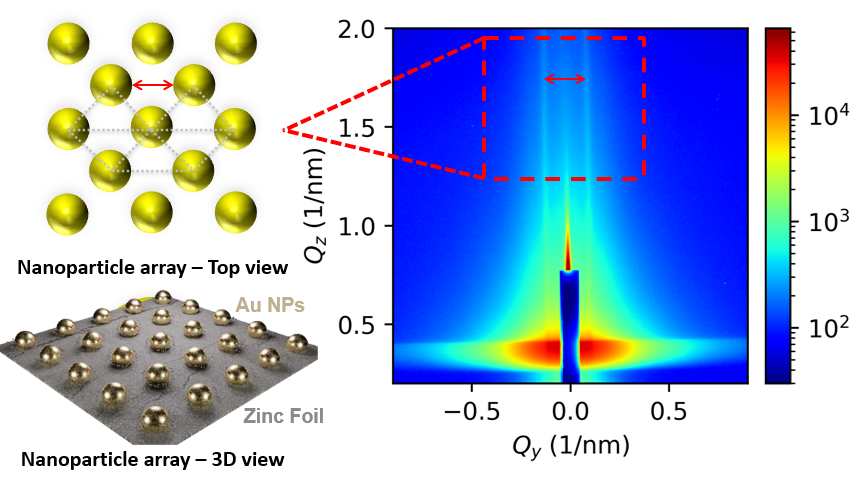
It was a revelation for us. There’s so little material on the
surface that it’s almost impossible to characterize by any other
means. But X-rays at the CLS provide a very strong signal, so we can
see it and we can confirm it’s there, and where it sits on the
surface.
Added Turak.
Now the team is studying how the particle-coating technology could
perform with copper electrodes for next-generation anode-free
batteries. They are also investigating whether sparse nanoparticles
could be used beyond batteries, in other technologies such as
sensors, photovoltaics, and lighting.
Watch a video about this research
-30-
More CLS science highlights
The Canadian Light Source (CLS) is a national research facility
of the University of Saskatchewan and one of the largest science
projects in Canada’s history. More than 1,000 academic,
government and industry scientists from around the world use the
CLS every year in innovative health, agriculture, environment, and
advanced materials research.
The Canada Foundation for Innovation, Natural Sciences and
Engineering Research Council, Canadian Institutes of Health
Research, the Government of Saskatchewan, and the University of
Saskatchewan fund CLS operations.
Greg Basky
Communications Coordinator
Canadian Light
Source
306-370-9446
greg.basky@lightsource.ca
Investorideas.com
is the go-to platform for big investing ideas. From breaking stock
news to top-rated investing podcasts, we cover it all.
Mining stocks -Learn more about our news, PR and social media,
podcast and content services at Investorideas.com
