

Texas Triangle Goes Hyperscale: How DFW, Abilene, and the
Stargate Buildout Are Redrawing the US Industrial Gas Map
Northern Virginia is still the largest data center market in the
world. But Northern Virginia is also a market that, by most credible
measures, has run out of usable runway. Grid congestion, multi-year
utility queues, and local political resistance have stalled new
large-scale projects there, and the hyperscalers have voted with
their cheques. They have come to Texas.
Dallas-Fort Worth is now the second-largest data center market in
North America. Abilene, a city most investors could not have placed
on a map two years ago, is now home to the operational flagship of
the $500 billion Stargate project, an OpenAI-Oracle-SoftBank
consortium that has reset the meaning of “scale” in AI
infrastructure. Together with Samsung’s Taylor semiconductor fab,
Texas Instruments’ Sherman expansion, and a half-dozen other
megaprojects, Texas has quietly become the center of gravity for the
entire US AI buildout.
For investors, this is not just an AI infrastructure story. It is an
industrial gas story, an electricity story, a real estate story,
and, for anyone trying to source nitrogen, oxygen, argon, or
specialty gases in the state, a structural supply-chain story. Here
is what the map actually looks like, and what it means.
The Scale of What Is Happening in Texas
Start with Dallas-Fort Worth. According to CBRE’s H2 2025 market
data, DFW has roughly 1 gigawatt of operational data center
capacity, with another 700 megawatts under construction, and that
under-construction space is 94.5% preleased before
it is even finished. An additional 3 gigawatts of greenfield
development is planned. Mordor Intelligence projects the Dallas
market alone will hit 2.55 GW by 2031, and that is just the
colocation segment.
Oncor, the dominant DFW utility, raised its five-year capital plan
from $1.2 billion a decade ago to
$36 billion in 2025, almost entirely to support
large commercial and industrial loads entering its service
territory. The utility’s interconnection queue for
commercial/industrial customers exceeded 137,000 megawatts at the
end of 2024, a roughly 250% year-over-year increase. That is not a
typo. The state’s data center demand is climbing faster than the
grid can be physically rebuilt.
DFW’s under-construction capacity is among the most preleased in
the country – buyers are committing to space before the concrete
is poured.
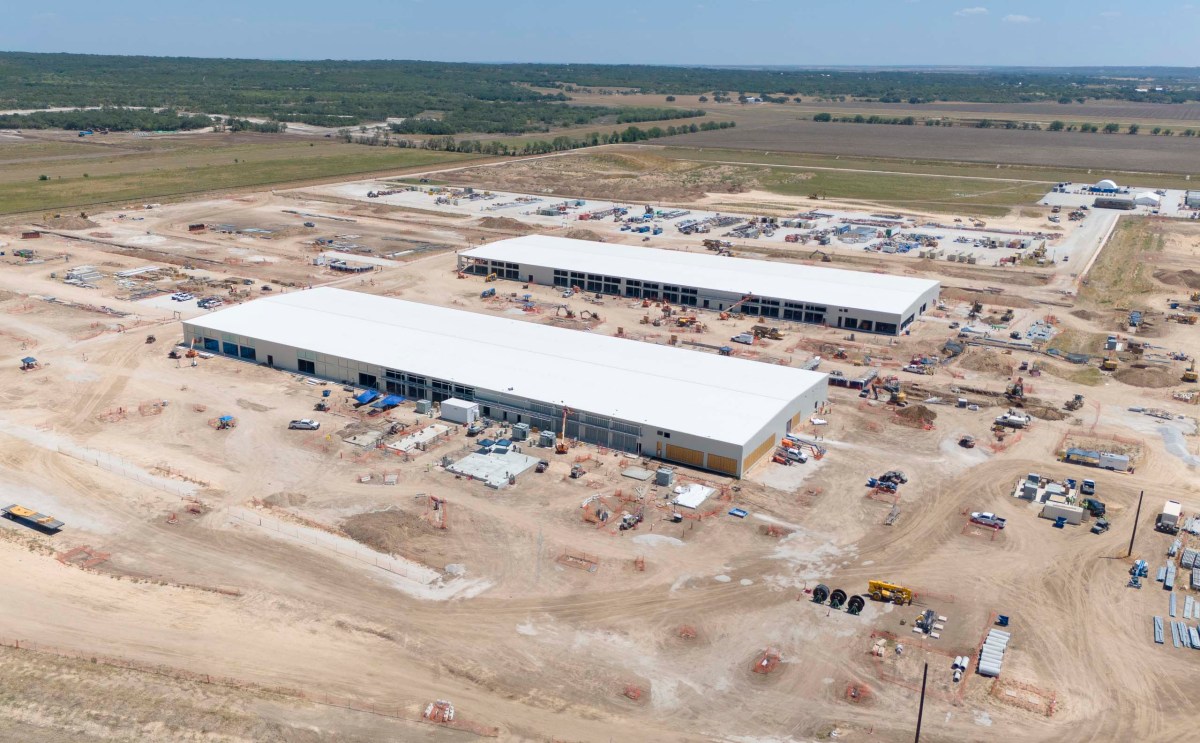
Then there is Stargate. The flagship Abilene campus, developed by
Crusoe on Lancium’s Clean Campus, will reach 1.2 GW at full buildout
with eight half-million-square-foot buildings deploying
more than 450,000 Nvidia GB200 GPUs under a 15-year
lease. Two buildings are already operational; the remaining six are
scheduled for mid-2026. Power is supplied by an on-site natural gas
microgrid plus grid power, including local wind. Just across the
county line in Shackelford County, Vantage is building a second
1,200-acre, 10-building campus for Stargate, with its own natural
gas microgrid. A third Texas Stargate site is under construction in
Milam County.
Add Samsung’s Taylor fab, TI’s Sherman expansion, Globitech, and a
wave of CHIPS Act-funded specialty foundry projects, and you have
something genuinely unprecedented: a single US state hosting the
simultaneous buildout of the largest AI training infrastructure in
history and some of the largest new semiconductor fabs in
the Western Hemisphere.
Texas is hosting AI infrastructure megaprojects at a scale and
density no other US state can match.
Every one of these facilities, without exception, runs on
industrial gas. The question is no longer whether the demand
exists. It is whether the supply chain can keep up.
Why This Is an Industrial Gas Story, Not Just an AI Story
Data centers and semiconductor fabs are extraordinarily
nitrogen-intensive operations, but for completely different reasons
that compound rather than overlap.
In data centers, nitrogen plays four distinct
roles: fire suppression (FM-200 and Inergen-class systems), inerting
of battery rooms and UPS infrastructure, purging of electrical
switchgear, and, increasingly, as GPU thermal design power climbs
above 700W per chip as a component in two-phase immersion cooling
and cryogenic burn-in testing. A single hyperscale facility at 200
megawatts of IT load can consume more nitrogen annually than a
mid-sized food processing plant.
In semiconductor fabrication, the consumption
profile is an order of magnitude larger. Modern fabs operate on
dedicated, on-site air separation units (ASUs) built by Linde, Air
Liquide, or Air Products under 15-to-20-year supply contracts.
Ultra-high-purity nitrogen (6N – 99.9999%) is used continuously for
wafer transport, process chamber purging, controlled atmospheres,
and as a carrier gas in deposition. Critically, AI chip complexity
is increasing nitrogen consumption per wafer, not
decreasing it. Each step down in the process node from 3nm to 2nm
and the chiplet packaging that goes with it means more process
steps, longer purge cycles, and tighter purity specifications.
Linde’s recent $200 million expansion of its Taiwan specialty gas
facility, a 40% increase in capacity for nitrogen trifluoride and
tungsten hexafluoride production, is a direct response to this
trend. The same logic is playing out in Texas. Every new fab
announcement creates a multi-decade industrial gas commitment that
gets locked in before the building is built.
The Texas Advantage
Texas has structural advantages that explain why this is happening
here rather than elsewhere. ERCOT, the state’s grid operator, runs
an energy-only market that historically delivers some of the
cheapest industrial electricity in the United States. Air separation
is one of the most electricity-intensive industrial processes on
Earth, roughly 0.3-0.4 kWh per cubic meter of nitrogen, which means
ASU operators can produce nitrogen in Texas at lower marginal cost
than almost anywhere else in the country. Add the JETI Act property
tax abatements, business-friendly permitting, and Texas’s central
national distribution geography, and you have an environment where
industrial gas majors have been concentrating ASU capacity for
years.
That advantage has now become a constraint. With Stargate Abilene,
DFW hyperscalers, Samsung Taylor, TI Sherman, and the Permian Basin
all pulling on Texas-based industrial gas supply simultaneously, the
merchant market, the segment serving everyone
other than the on-site contracted megaprojects, is feeling
allocation pressure for the first time in a decade.
This is where the investor and operator lenses diverge sharply. For
the four global majors (Linde, Air Liquide, Air Products, Messer),
Texas is one of the most attractive demand environments in their
global portfolio: long-duration contracts, high-credit-quality
counterparties, and the ability to pass through power costs. For
mid-market industrial buyers in the state, food processors,
electronics assembly operations, oilfield services, laboratory and
research facilities, fabrication shops, and beverage producers, the
question of supply reliability has moved from “taken for granted” to
“actively managed.”
Independent Texas-based distributors, including
Southwest Gases, a nitrogen supplier serving major
Texas cities, increasingly act as the allocation buffer for buyers
who do not have the volume to lock in their own on-site ASU but who
cannot afford to lose supply continuity.
The Investor Lens: What Texas’s AI Buildout Means for Industrial
Gas Equities
Three things matter from here for anyone holding industrial gas
majors as an AI-adjacent play.
First, on-site contract disclosures. Linde’s 2024
sales of $33 billion already lean heavily on electronics and on-site
segments. As Stargate sites and Texas fabs sign multi-decade on-site
supply contracts, expect this category to grow meaningfully in
2026-2028 reporting. Air Products has historically been more
hydrogen-tilted; watch whether they pivot into the Texas data center
supply opportunity. Air Liquide’s electronics franchise is its
highest-margin segment globally.
Second, ERCOT and behind-the-meter generation. The
Texas grid cannot interconnect new large loads fast enough – wait
times for major industrial interconnection have stretched, and
developers are increasingly turning to behind-the-meter natural gas
generation to bypass the queue. Stargate Abilene and the new
Shackelford County campus both operate on natural gas microgrids.
This is bullish for any equity exposed to behind-the-meter
generation, gas turbine OEMs, and the integrated
power-plus-data-center developer model.
Third, regional consolidation. The independent
industrial gas distributor segment in Texas is one of the most
fragmented in the country. As majors prioritize hyperscaler and fab
contracts, regional independents become both more valuable to
mid-market customers and more attractive as M&A targets.
Messer’s roughly $5 billion acquisition of Linde divestitures set
the recent benchmark; expect more activity in the Texas mid-market.
Where This Lands
The simplest way to describe what is happening in Texas is this: the
state has become a stress test for whether American industrial
supply chains can scale at the pace of the AI capital cycle. Power,
water, land, semiconductors, optical components, switchgear, cooling
equipment, construction labor, and industrial gas – every one of
these is being pulled on simultaneously, in concentrated geography,
with deep-pocketed counterparties willing to pay for priority.
Industrial gas, quietly, may be one of the better-positioned links
in that chain. The molecules are abundant. The technology to produce
them at scale is mature. The four majors have the balance sheets to
build new capacity. What they need is what every commodity supplier
needs at the start of a structural demand cycle: long contracts,
captive customers, and pricing power. Texas is handing them all
three.
For Texas industrial buyers who are not building 1.2 GW data centers
but who still need reliable nitrogen, oxygen, argon, or CO2 tomorrow
morning, the same lesson applies that has applied in every commodity
squeeze: source local, build redundancy, and pay attention to what
the majors are not telling you they are doing with their best
molecules. The AI buildout will not stop. Neither will the
industrial gas demand that comes with it.
Research energy stocks at Investorideas.com’s free stock
directory
https://www.investorideas.com/OGSN/stock_list.asp
Investorideas.com is a trusted platform for retail investors, serving
as a hub for innovative investing ideas for over 25 years. Known for
its pioneering coverage of sectors like mining, cleantech, defense,
and water stocks, the company and its executives have been featured in
high-profile media outlets for its expertise. Investorideas.com is
always at the forefront of investment trends, offering coverage of
diverse industries such as AI, mining, and tech. With a mission to
empower investors, the company provides breaking news, sector-focused
articles, podcasts, and exclusive interviews with leading experts. In
addition, its award-winning branded content, AI-driven short videos,
and podcasts highlight key investing insights and feature prominent
industry leaders.
Why partner with Investor Ideas? Discover our powerful news, PR,
social media, and podcast solutions for crypto stocks at
Investorideas.com
Why should companies choose Investor Ideas for digital advertising and
guest posts?
Investors stay ahead by signing up for free stock news alerts at
Investorideas.com
